
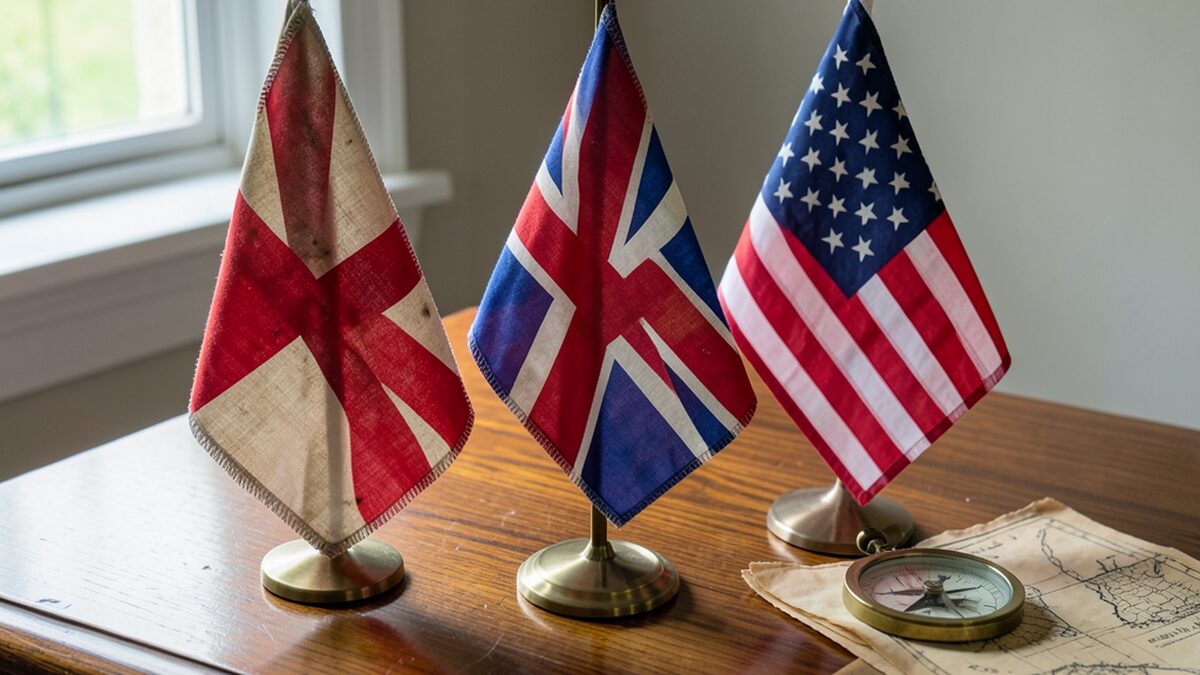
The evolution of early American flags reveals a complex interplay between British imperial heritage and burgeoning colonial self-expression. By examining how the Union Jack and local emblems were integrated into colonial banners, one uncovers the nuanced tensions shaping identity during this transformative era. This fusion of symbols not only mirrored political loyalties but also laid the groundwork for the distinctive design elements that would define the United States flag.
Key Takeaways
- Early American colonial flags prominently featured the Union Jack, symbolizing British authority.
- Colonial flags often combined British naval elements with local symbols to express regional identity.
- The design evolution of colonial flags influenced the creation of the United States’ stars and stripes.
- Colonial flags reflected a balance between loyalty to Britain and emerging American independence.
In the mid-18th century, as thirteen British colonies along the Atlantic seaboard began to articulate their distinct identities, their banners and ensigns bore unmistakable marks of imperial heritage. The Union Jack, symbolizing the authority of the British Crown, frequently appeared in the canton of colonial flags, reflecting both allegiance and emerging regional pride. Simultaneously, the proliferation of locally adapted designs—often incorporating elements from British naval flags and colonial seals—laid the visual groundwork for what would become the stars and stripes of the United States. Understanding the interplay between British and colonial vexillology during this formative period reveals how early American flags navigated the tension between inherited symbolism and burgeoning independence.
British Flags as the Default Visual Language in the Colonies
Prior to the American Revolution, the visual landscape of the thirteen colonies was dominated by British flags, which served as the primary symbols of authority and identity. Commonly flown ensigns included the King’s Colors, the British Red Ensign, and the white flag bearing the red cross of St. George. These flags were not merely decorative but functioned as explicit markers of British sovereignty, flown over government buildings, military forts, and naval vessels. The Red and Blue Ensigns, variants used throughout the British Empire, were particularly influential in shaping the colonial flag repertoire. English settlers in New England, keen to maintain their status as English subjects, incorporated English heraldic forms into their banners, reinforcing a shared imperial identity.
Understanding the interplay between British and colonial vexillology during this formative period reveals how early American flags navigated the tension between inherited symbolism and burgeoning independence.
By the early 18th century, the visual system within the colonies was deeply entrenched in British maritime and state symbolism. This embeddedness meant that the flags emerging in colonial contexts were extensions of familiar imperial iconography rather than radical departures. The continuity in design elements between British flags and colonial banners established a visual language that would later ease the transition to distinctly American symbolism. The omnipresence of British flags underscored the political reality of colonial dependence while simultaneously setting a foundation for evolving regional identities.
The Grand Union Flag: A Hybrid Symbol of Transition
The Grand Union Flag, also known as the Continental Colors, epitomizes the complex relationship between British and colonial symbolism during the revolutionary era. Its design consisted of thirteen alternating red and white stripes representing the thirteen colonies, combined with the British Union Flag in the canton, which symbolized the union of England and Scotland. This juxtaposition of elements visually articulated the colonies’ collective identity while maintaining a symbolic connection to the British Crown.
First flown by the Continental Army in Boston in early 1776 and later at General Washington’s headquarters at Prospect Hill, the Grand Union Flag functioned as a transitional emblem. Its stripes acknowledged the unity and distinctiveness of the colonies, while the British Union in the canton indicated the lingering hope for reconciliation with Britain. The flag’s widespread recognition among colonists and British observers alike reflects its role as a bridge between imperial allegiance and revolutionary aspiration, marking a pivotal moment in the evolution of American vexillology.
The British Union in the Canton: Signaling Loyalty and Protest
The presence of the British Union Flag in the canton of early American flags was laden with dual meaning. On one hand, it visibly asserted the colonies’ status as British territories and signaled loyalty to the Crown. Many delegates in the Second Continental Congress continued to advocate for reconciliation and sought to assert colonial rights within the framework of the British Empire. The retention of the Union Flag in early designs underscored this political stance, reflecting a desire to negotiate grievances rather than sever ties outright.
Conversely, the incorporation of the British Union also functioned as a subtle form of protest. By pairing the Union Flag with thirteen stripes symbolizing colonial unity and autonomy, early American flags challenged the existing order and articulated a vision of self-governance. This nuanced symbolism highlighted the colonies’ complex relationship with Britain—simultaneously affirming cultural roots and asserting emerging independence. The evolution of flag designs from this point forward gradually removed direct British elements, but the initial influence of British and colonial flags on early American flag designs remained a foundational aspect of the nation’s visual and political identity.