
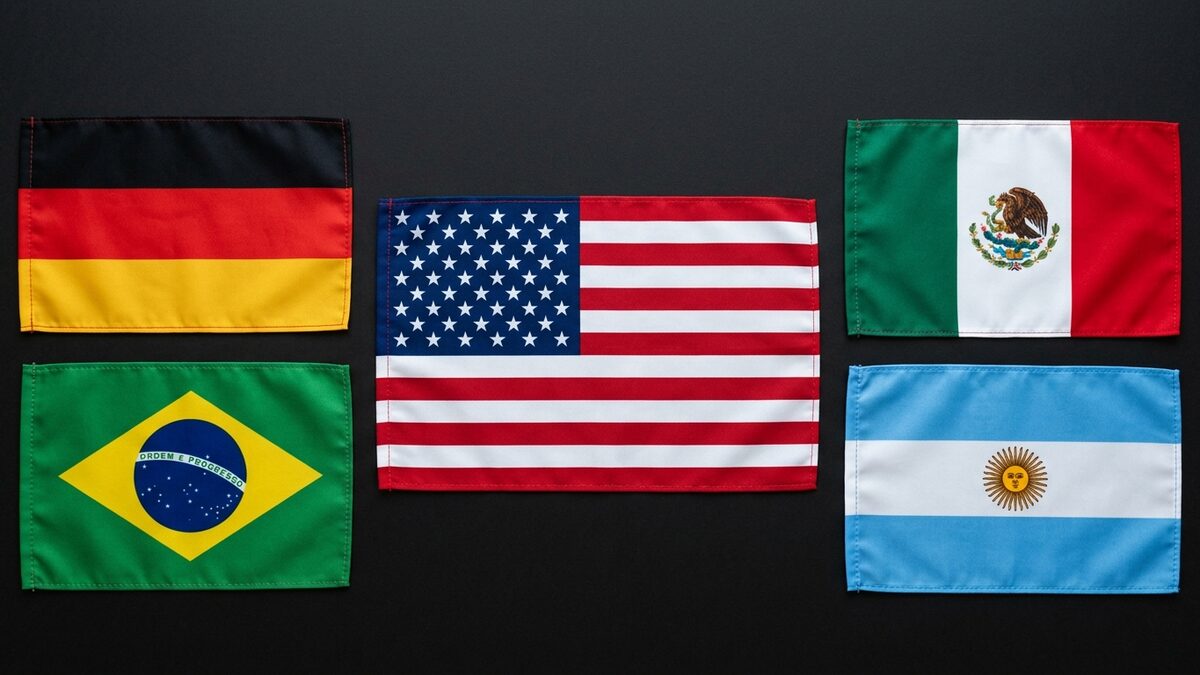
This article presents a compelling comparative analysis of the US flag alongside those of other federal republics, revealing distinct visual strategies that reflect differing conceptions of federalism. While the American flag prioritizes unity through its consistent design elements, flags from Germany, India, and Brazil incorporate diverse regional symbols to celebrate their constituent identities. Such contrasts provoke important questions about how national identity and federal structure are communicated through symbolism.
Key Takeaways
- The U.S. flag balances historical continuity with evolving representation through its stripes and stars.
- American flag design emphasizes unity using repetition and symmetry.
- Other federal republics use color bands and emblems to highlight regional diversity.
- Different flags reflect federalism either by abstract unity or by celebrating constituent identities.
The flag of the United States, with its thirteen stripes and fifty stars, embodies a balance between historical continuity and evolving representation, standing in stark contrast to the often more segmented or emblematic designs of other federal republics. Where the American flag emphasizes unity through repetition and symmetry, flags such as those of Germany, India, and Brazil employ color bands, symbolic emblems, or regional motifs to reflect the diverse identities within their federations. This juxtaposition reveals differing approaches to expressing federalism visually—either through abstract symbolism that underscores unity or through distinct regional elements that celebrate constituent diversity.
Design and Legal Foundations of the U.S. Flag
The United States flag features thirteen alternating red and white stripes representing the original British colonies, and fifty white stars arranged in nine offset rows on a blue canton symbolizing the current fifty states. The flag’s proportions are officially set at 10:19, maintaining a precise geometric balance. Its design dates back to 1777 when it was first adopted as a naval ensign through the Flag Resolution, rather than being explicitly defined in the U.S. Constitution. Since 1818, the flag has evolved incrementally, with new stars added on July 4th following each state’s admission into the Union. This incremental approach to modification reflects a symbolic continuity that connects the nation’s founding with its ongoing expansion, emphasizing unity through consistent visual elements rather than frequent redesigns.
The flag of the United States, with its thirteen stripes and fifty stars, embodies a balance between historical continuity and evolving representation, standing in stark contrast to the often more segmented or emblematic designs of other federal republics.
Flags Closely Resembling the U.S. Flag
The distinctive “stars and stripes” motif of the U.S. flag has inspired a family of national flags that share similar structural elements. Countries such as Chile, Cuba, Greece, Liberia, Malaysia, Togo, and Uruguay incorporate stripes and a blue canton with symbolic stars or celestial emblems, reflecting the influence of American flag design on their own national identities. Liberia’s flag is a particularly close analogue, featuring red and white stripes and a blue square canton with a single white star, underscoring its historical connection to the United States as a nation founded by freed American slaves. Malaysia’s flag also includes a blue canton, but replaces stars with a yellow crescent and sun; its resemblance to the U.S. flag is often described as coincidental rather than derivative. The spread of this design template beyond the Americas, as seen in Togo and Uruguay, illustrates how the visual language of stripes and canton symbolism has been adapted in various republican contexts to express federalism and national unity.
Indirect and Stylistic Influences on Other Federal Republic Flags
Beyond direct copies or adaptations, the U.S. flag’s influence extends into a broader republican visual language that informs the flag designs of other federal republics. For example, Brazil’s national flag, while distinct in its use of green and yellow and a prominent central globe, has been suggested in informal comparisons to incorporate star arrangements inspired by older U.S.-style designs, reflecting a conceptual rather than explicit influence. Similarly, Somalia’s flag, predominantly a simple blue field with a single white star, shares the emblematic use of a star as a unifying symbol, resonating with the American flag’s emphasis on stars to represent constituent states. These cases demonstrate that the expression of federalism through flags can be either direct or diffuse, with some nations drawing stylistic inspiration from the U.S. model while others develop unique representations that communicate unity and diversity in different visual terms.