The flag folding ritual, rooted in 18th-century naval customs, has transformed into a profound military ceremony rich with symbolism and respect. Each precise fold and deliberate movement conveys a deep tribute to service and sacrifice, embodying enduring traditions that connect soldiers to their nation. Exploring the origins and significance of this practice reveals how such rituals preserve military heritage and honor the values that define a country’s identity.
Key Takeaways
- Flag folding rituals originated from 18th-century naval traditions emphasizing discipline and respect.
- The ceremony is a solemn military practice symbolizing honor and sacrifice.
- The folded flag's triangular shape represents national unity and spirit.
- Trained personnel perform the ritual with precise, coordinated movements.
The practice of folding the flag dates back to early naval traditions in the 18th century, when careful handling of the ensign signified discipline and respect aboard vessels. Over time, this ritual evolved into a solemn ceremony integral to military funerals and formal events, embodying centuries of reverence for national symbols and the values they represent. The precise folds and measured movements reflect a continuum of military customs designed to honor service, sacrifice, and the enduring bond between soldier and country.
The Flag Folding Ritual: Definition and Context
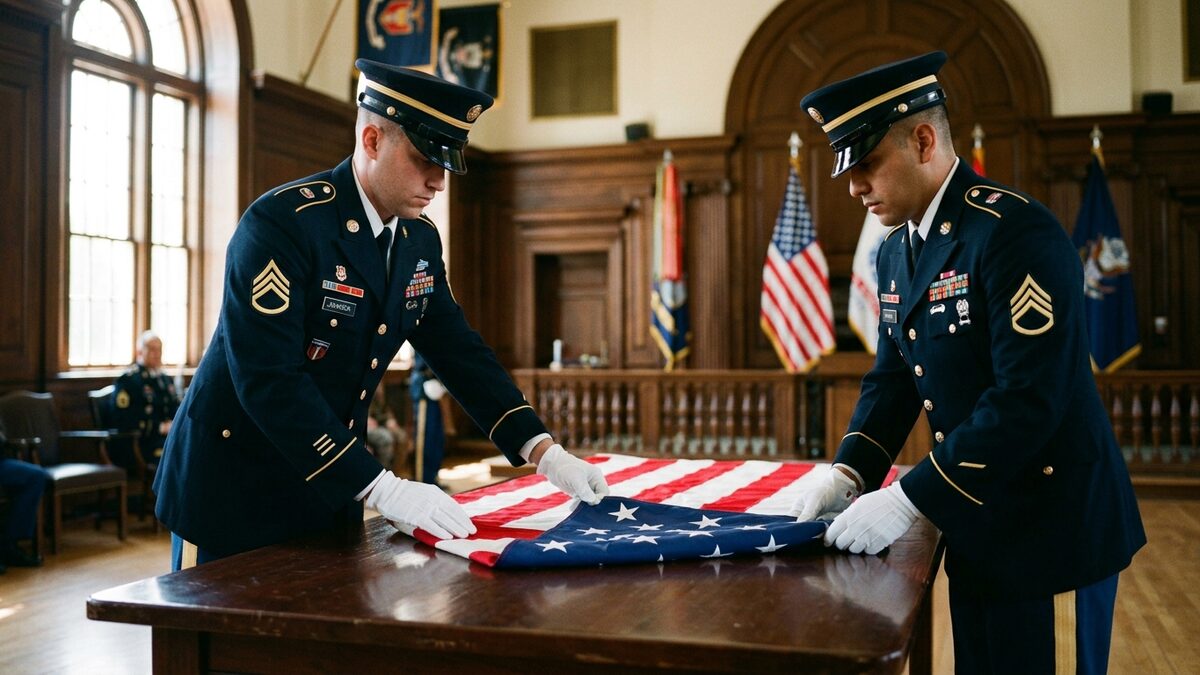
Flag folding rituals serve as a formalized method to honor the flag and, by extension, the individual or institution it represents. In the United States military context, this ceremony is most prominently featured during funerals, retirement ceremonies, and other solemn occasions. The ritual culminates in the flag being folded into a compact, tight triangle, revealing only the blue field of stars. This specific shape and presentation are designed to symbolize the unity and enduring spirit of the nation. Far from a casual gesture, the ceremony involves coordinated handling by trained personnel, emphasizing precision and respect in every movement. Organizations such as the American Legion highlight the flag-folding ritual as a tribute to the nation’s honored dead and military service, linking the physical act of folding to a broader narrative of sacrifice and national identity.
The precise folds and measured movements reflect a continuum of military customs designed to honor service, sacrifice, and the enduring bond between soldier and country.
Official Military Procedure for Flag Folding
The flag folding ceremony follows a prescribed procedure established by military protocols, ensuring consistency and dignity in its execution. Military OneSource outlines that the process begins with two individuals positioned at each end of the flag, holding it waist-high and parallel to the ground. The first fold involves folding the lower half of the striped section lengthwise over the blue field of stars. Subsequent steps consist of repeated triangular folds, progressively reducing the flag’s size while maintaining its shape. The final folded flag displays only the triangular blue field with stars, symbolizing the union of states and the nation as a whole. Any excess fabric extending beyond the blue field is carefully tucked inside, preventing any part of the stripes from being visible. This meticulous procedure underscores the importance of uniformity and symbolism in military tradition, reinforcing respect for the flag as a sacred emblem.
Symbolism and Meaning Attributed to the Flag Folds
The individual folds of the flag have acquired rich symbolic meanings over time, many of which are linked to religious and patriotic principles. According to the American Legion, the ceremony embodies ideals associated with the nation’s founding, connecting the flag to themes of remembrance and resurrection. For instance, the first fold is said to represent life itself, while the second fold signifies belief in eternal life, reflecting a spiritual dimension to the ritual. The third fold is traditionally interpreted as honoring the veteran departing the ranks, acknowledging their service and sacrifice. These symbolic interpretations are often recited during ceremonies to impart deeper meaning to the ritual. However, it is important to note that such meanings are not officially mandated by the military and can vary depending on the organization or context. Despite this, the persistent use of these interpretations attests to the flag folding ritual’s role as a living tradition, evolving yet grounded in its core purpose of respect and remembrance.