
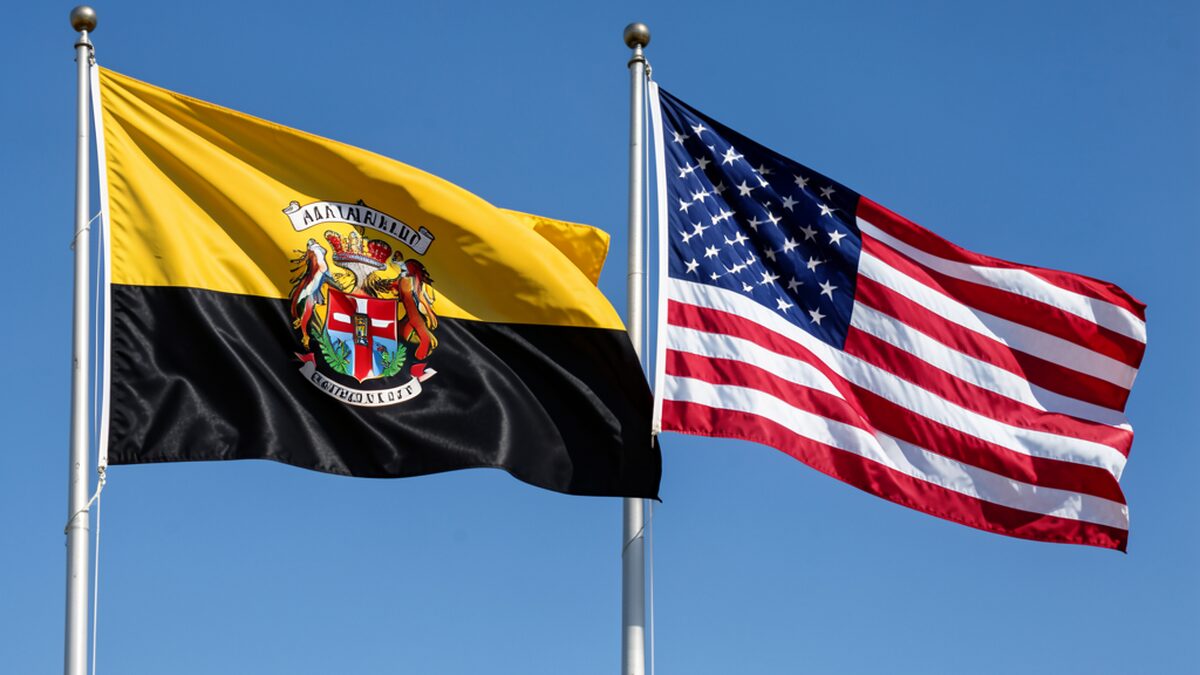
The evolution of American flags reveals a fascinating interplay between national unity and regional identity. Maryland’s state flag, rooted in colonial heraldry, offers a striking contrast to the stars and stripes that represent the United States as a whole. Exploring the origins and symbolism of these flags uncovers deeper narratives about heritage, allegiance, and the diverse fabric of American history that continue to resonate today.
Key Takeaways
- The Maryland state flag combines the heraldic symbols of the Calvert and Crossland families.
- It was officially adopted to represent Maryland's unique colonial heritage.
- The US flag symbolizes national unity, while Maryland's flag emphasizes regional identity.
- Maryland's flag design dates back to the colonial era, contrasting with the stars and stripes of the US flag.
In 1781, as the American Revolution drew to a close with the British surrender at Yorktown, the colonies were not only forging a new nation but also cultivating distinct symbols of identity and unity. Among these symbols, flags emerged as potent emblems, with the United States flag representing a collective federal identity, while individual states like Maryland adopted banners steeped in regional heritage and historical allegiance. The Maryland state flag, with origins tracing back to the heraldic banner of Lord Baltimore, contrasts sharply with the stars and stripes of the US flag, offering a unique lens through which to examine the interplay of national unity and local tradition in American vexillology.
Origins and Official Adoption of the Maryland State Flag
The Maryland state flag is deeply rooted in the heraldic traditions of the Calvert and Crossland families, colonial proprietors of the Maryland territory. The flag’s design features the black-and-gold pattern of the Calverts in the first and fourth quarters, while the red-and-white cross bottony of the Crossland family occupies the second and third quarters. This distinctive quartered design first appeared publicly on October 11, 1880, during a Baltimore parade commemorating the city’s 150th anniversary. Despite its deep historical symbolism, it was not until 1904 that the Maryland General Assembly officially adopted the flag as the state’s emblem, under Chapter 48, Acts of 1904, effective March 9 of that year. This adoption marked the flag as a post-Civil War symbol, although its heraldic elements date back to the early colonial period. Notably, Maryland’s flag remains unique among U.S. state flags for directly incorporating the heraldry of its colonial proprietors, distinguishing it within the broader landscape of American state symbols.
The Maryland state flag, with origins tracing back to the heraldic banner of Lord Baltimore, contrasts sharply with the stars and stripes of the US flag, offering a unique lens through which to examine the interplay of national unity and local tradition in American vexillology.
Symbolism and Historical Meaning Embedded in the Flag
The design of the Maryland state flag encapsulates a layered symbolism reflecting both familial lineage and broader state identity. The black-and-gold quarters represent the Calvert family, specifically George Calvert, the first Lord Baltimore and founder of the Maryland colony. The red-and-white quarters, featuring a cross bottony, symbolize the Crossland family, Calvert’s maternal line. This heraldic combination not only honors the founding families but also embodies the reunification of Maryland’s citizens following the Civil War. According to the Maryland Secretary of State, the flag’s alternating quadrants became a symbol of reconciliation and unity during the post-war era. The flag also carries specific legal requirements, such as the mandate that a gold cross bottony be used as the staff ornament when affixed to a flagpole, underscoring the importance of heraldic accuracy and tradition in the flag’s display.
Civil War Context and the Flag’s Role in Reconciliation
The Maryland flag’s history is inseparable from the complex political dynamics of the Civil War within the state. Maryland, a border state with divided loyalties, saw Confederate sympathizers and soldiers rally around the red-and-white Crossland colors and the distinctive cross bottony as symbols of their identity. Conversely, Unionist Marylanders adopted the black-and-gold Calvert colors, visually delineating political affiliations through heraldry. This dual use of the flag’s components reflected the state’s internal divisions during the conflict. After the war, however, the combined flag design emerged as a powerful emblem of unity, symbolizing the reconciliation of Maryland’s citizens. Preservation Maryland highlights that the flag’s alternating quarters have since come to represent the healing of divisions and the restored cohesion of the state within the Union. Thus, the Maryland state flag serves not only as a historical artifact but also as a testament to the complex interplay between regional identity and national unity in the post-Civil War United States, standing in contrast yet complementing the US flag’s broader federative symbolism.