
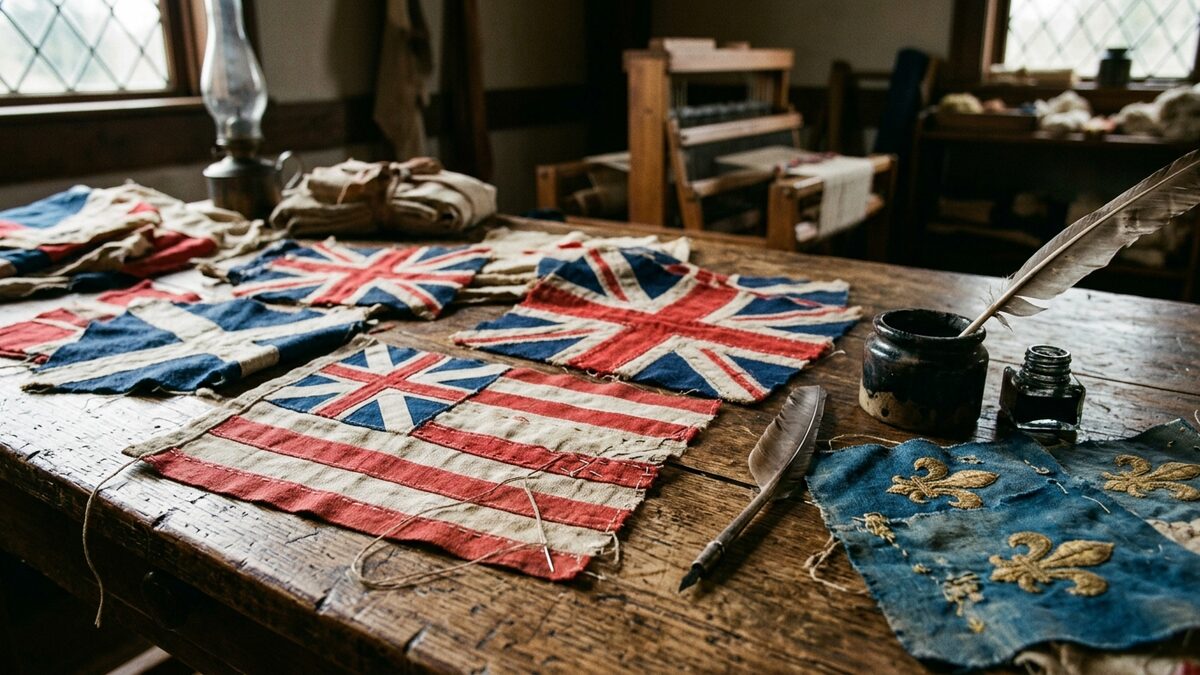
The evolution of early American flag designs reveals a fascinating interplay between emerging national identity and enduring colonial ties. By incorporating elements from British and French flags, these symbols conveyed more than mere decoration—they embodied the political complexities and diplomatic nuances of the post-Revolutionary era. Exploring these influences offers valuable insight into how the fledgling United States navigated its path between rebellion and allegiance.
Key Takeaways
- Early American flags incorporated British and French elements to reflect both independence and colonial ties.
- The Grand Union Flag combined thirteen stripes with the British Union Jack in its canton.
- French tricolor colors influenced the color schemes of some American flags.
- Flag designs symbolized complex themes of allegiance, rebellion, and diplomacy.
In the wake of the American Revolution, the nascent United States faced the challenge of creating symbols that both asserted its independence and reflected its colonial heritage. Among these, the design of the national flag drew heavily on the visual language of British and French ensigns, nations whose political and military presence shaped early American identity. The incorporation of elements such as the Union Jack’s crosses and the French tricolor’s color schemes into American flags during the late eighteenth century reveals a complex interplay of allegiance, rebellion, and diplomacy, underscoring how early American flag designs were deeply influenced by their European antecedents.
British Union Symbolism in the First Continental Flags
The earliest American flags prominently featured British symbolism, notably the Continental Colours, also known as the Grand Union Flag, which was first raised on January 1, 1776, at Prospect Hill in Charlestown, Massachusetts. This flag incorporated 13 alternating red and white horizontal stripes representing the thirteen colonies, but its canton bore the British Union Flag, combining the crosses of St. George and St. Andrew. The presence of the Union Jack in the canton signified the colonies’ initial political connection to Britain despite escalating tensions. George Washington’s directive to raise this flag highlighted the continued identification with British heritage during the early Revolutionary period, reflecting a complex allegiance rather than outright repudiation. Several early American flags retained similar British Union motifs prior to the formal standardization of the national flag by Congress.
The incorporation of elements such as the Union Jack’s crosses and the French tricolor’s color schemes into American flags during the late eighteenth century reveals a complex interplay of allegiance, rebellion, and diplomacy, underscoring how early American flag designs were deeply influenced by their European antecedents.
British Red Ensign and East India Company Influence
The design of the Grand Union Flag also drew from British maritime traditions, particularly the British Red Ensign and the flag of the British East India Company. The flag’s combination of horizontal stripes with a canton was characteristic of British maritime flags, a practical template familiar to colonial sailors and militias. Scholars and the American Battlefield Trust have noted that the Grand Union Flag’s design bears striking resemblance to the British East India Company flag used from 1701 to 1801, which featured red and white stripes with the British Union in the canton. This connection suggests that early American flag designs were influenced not solely by symbolic considerations but also by pragmatic adoption of established maritime ensigns. British naval and commercial flags provided a visual framework that facilitated the creation of flags that balanced colonial identity with recognizable elements of imperial authority.
Congressional Break from British Symbols in 1777
The formal severance from British symbolism occurred on June 14, 1777, when the Continental Congress adopted the first official United States flag design. This resolution specified a flag with 13 alternating red and white stripes and 13 white stars arranged in a blue field, eliminating the British Union canton present in the Grand Union Flag. This change was significant, marking a clear rejection of British imperial insignia while retaining the red, white, and blue color scheme, which itself alluded to both British and French influences. The adoption of stars in a blue canton introduced a distinctively American symbol representing unity and sovereignty. June 14th has since been commemorated as Flag Day, underscoring the flag’s importance as a national emblem that both acknowledged colonial heritage and asserted independent identity.