
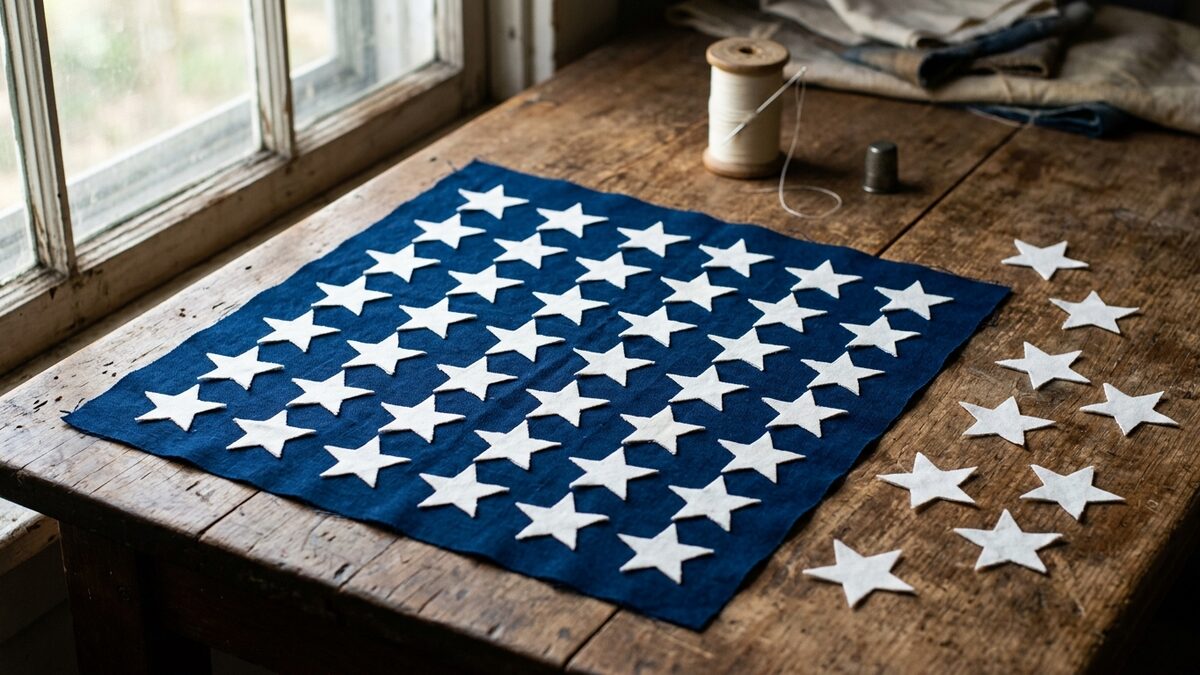
The evolution of the American flag’s design reflects the nation’s growth and shifting identity over centuries. The adoption of the 50-star flag in 1960 marked a significant milestone, symbolizing the culmination of territorial expansion and statehood. Exploring how this emblematic design emerged reveals insights into the broader narrative of American unity, political change, and the enduring symbolism that continues to resonate in the country’s visual heritage.
Key Takeaways
- The 50-star American flag design was officially adopted on July 4, 1960.
- The design reflects the inclusion of Alaska and Hawaii as the last two states admitted to the Union.
- The current flag continues a tradition that began with the original 13-star flag of 1777.
- Planning for the 50-star flag began years before Hawaii's statehood, showing foresight in federal design efforts.
In the wake of the United States’ westward expansion and the admission of new states into the Union during the mid-20th century, the American flag underwent a series of transformations reflecting the nation’s evolving identity. The 50-star design, officially adopted on July 4, 1960, emerged as a symbolic culmination of this territorial growth, incorporating the stars representing Alaska and Hawaii, the last two states admitted before the design was finalized. Rooted in a tradition dating back to the original 13-star banner of 1777, the current configuration embodies a historical narrative of political integration and national unity amidst changing demographics and geopolitical realities.
Early Conceptions of the 50-Star Flag
The concept of a 50-star American flag predates the formal inclusion of Hawaii as the 50th state, indicating that the design did not emerge spontaneously in 1959 but was the product of prior federal planning. Archival evidence, including a 1953 letter preserved at the Eisenhower Presidential Library, references discussions about “many possible arrangements of 49 stars and of 50 stars,” highlighting a proactive approach to accommodating potential future states. Photographs from the early 1950s reveal that flag designs resembling the modern 50-star pattern were already in circulation, underscoring the continuity and foresight in the flag’s evolution.
The 50-star design, officially adopted on July 4, 1960, emerged as a symbolic culmination of this territorial growth, incorporating the stars representing Alaska and Hawaii, the last two states admitted before the design was finalized.
This early iteration of the 50-star layout reflects a broader federal strategy anticipating the nation’s growth. Rather than creating the design ex nihilo following Hawaii’s admission, the final star arrangement grew organically from previous proposals and committee deliberations. This pattern was shaped by practical considerations of symmetry and aesthetics while maintaining the flag’s symbolic coherence, thus bridging historical tradition with contemporary realities.
Alaska’s Admission and the 49-Star Flag Redesign
Alaska’s entry into the Union as the 49th state on January 3, 1959, marked the first trigger for an official redesign of the American flag since the 48-star version had been in use since 1912. On the very day of Alaska’s admission, President Dwight D. Eisenhower issued Executive Order 10798, which formalized the 49-star flag design. This new design was not a radical departure but rather a measured adaptation that preserved the overall pattern of the previous flag while incorporating an additional star.
The redesign process involved a presidentially appointed committee tasked with advising on the appropriate star arrangement. The committee recommended a configuration that closely resembled the existing 48-star flag, reflecting a preference for continuity and respect for established symbolism. This cautious approach underscored the flag’s role as a unifying emblem during a period of rapid political change and territorial expansion.
Hawaii’s Statehood and the Final 50-Star Configuration
Hawaii’s admission on August 21, 1959, necessitated a second and final redesign of the flag to accommodate the 50th star. Responding swiftly, President Eisenhower issued Executive Order 10834 on the same date, officially establishing the 50-star flag design. This design retained the traditional thirteen stripes representing the original colonies, while the star arrangement was carefully crafted to symbolize the union of all 50 states.
The executive order also standardized the flag’s proportions and star layout, ensuring uniformity in production and display. The rapid federal response to Hawaii’s statehood reflected the necessity of maintaining the flag’s relevance as a living symbol of national identity. The 50-star flag was formally adopted on July 4, 1960, coinciding with Independence Day celebrations and cementing its place in the visual and political culture of the United States.