
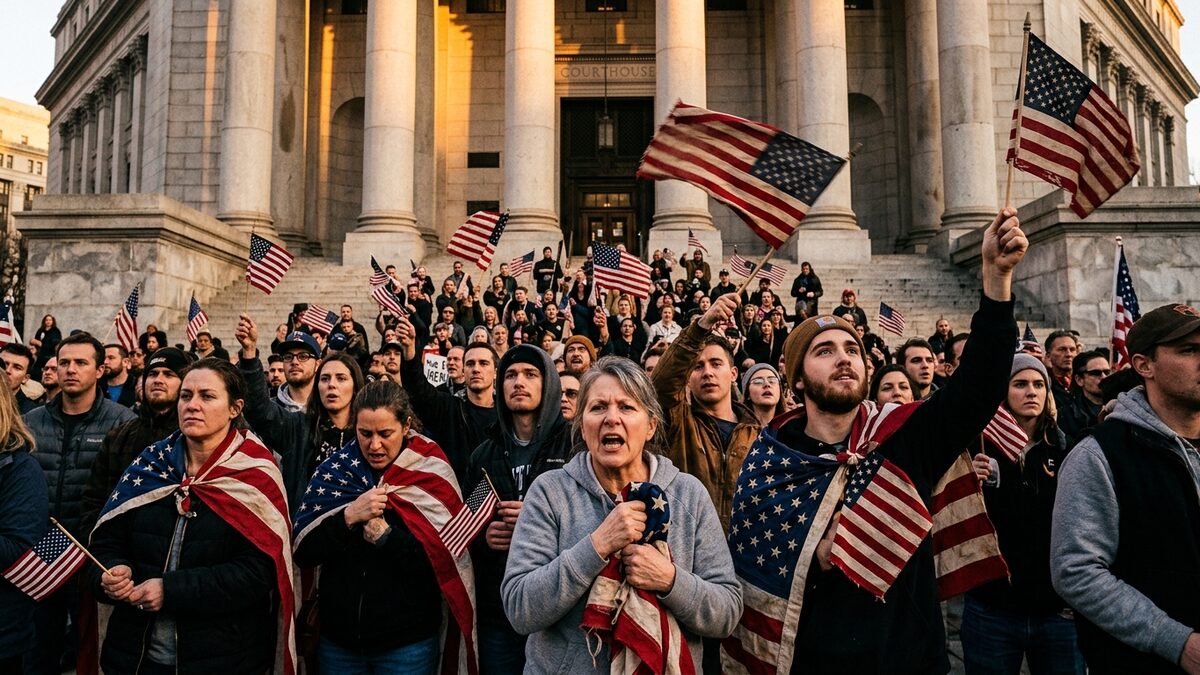
The U.S. flag’s dual role as a cherished national symbol and a powerful instrument of political protest has ignited profound legal and cultural debates throughout the 20th century. Key Supreme Court rulings have navigated the delicate balance between patriotism and free speech, challenging conventional perceptions of respect and dissent. Exploring these landmark cases reveals the evolving dynamics of constitutional rights and national identity in the context of political expression.
Key Takeaways
- The U.S. flag has been a central symbol in political protests since the early 20th century.
- Supreme Court rulings like Texas v. Johnson and United States v. Eichman affirm flag desecration as protected speech.
- The Court balances respect for the flag with First Amendment rights in cases of political expression.
- Early cases such as Spence v. Washington helped define the legal boundaries of flag-related speech.
Since the early 20th century, the United States flag has served not only as a national emblem but also as a powerful symbol in political expression and dissent. From the silent protests of the Vietnam War era to contemporary demonstrations, the flag’s presence in public discourse has sparked intense legal and societal debates. The Supreme Court has repeatedly confronted the tension between flag desecration as a form of protest and the government’s interest in preserving national symbols, most notably in landmark cases such as Texas v. Johnson (1989) and United States v. Eichman (1990). These rulings underscore the evolving judicial recognition of the flag’s dual role as both a revered icon and a vehicle for protected speech under the First Amendment.
Early Supreme Court Treatment of Flag Expression
The Supreme Court’s initial engagement with the issue of flag-related expression came in Spence v. Washington (1974), where the Court examined whether attaching a peace symbol to the U.S. flag constituted protected speech. The case arose when a college student was penalized under a Washington statute that criminalized publicly casting contempt upon the flag through actions such as mutilation or defacement. The Court ruled that the student’s conduct was protected expressive conduct under the First Amendment. This decision marked a significant shift by recognizing flag-related acts as symbolic speech rather than mere conduct subject to criminal sanction.
These rulings underscore the evolving judicial recognition of the flag’s dual role as both a revered icon and a vehicle for protected speech under the First Amendment.
Spence is often cited as a foundational case distinguishing constitutionally protected expression from unlawful misuse of the flag. It established a framework for analyzing whether particular conduct communicates a message that merits First Amendment protection. This early precedent laid the groundwork for subsequent Supreme Court rulings addressing the complex balance between free speech and government interests in maintaining the flag’s symbolic integrity.
Texas v. Johnson and the Protection of Flag Burning
The landmark case Texas v. Johnson (1989) further defined the constitutional boundaries governing flag desecration in political protests. Gregory Lee Johnson burned an American flag during the 1984 Republican National Convention as a form of political dissent. The State of Texas prosecuted Johnson under a flag desecration law, but the Supreme Court, in a narrow 5–4 decision, held that flag burning constituted symbolic speech protected by the First Amendment.
The Court rejected the argument that the government’s interest in preserving the flag’s sanctity justified prohibiting offensive speech. It emphasized that the government cannot ban expression simply because it is disagreeable or provocative. The ruling invalidated state laws punishing flag desecration in the context of political protest, establishing a strong precedent affirming that the US Flag in Political Protests and Supreme Court Rulings is a matter of constitutional free speech protection rather than criminal conduct.
Congressional Response: The Flag Protection Act of 1989
In response to the Texas v. Johnson decision, Congress enacted the Flag Protection Act of 1989. This statute aimed to prohibit certain acts against the U.S. flag regardless of whether the conduct occurred during a political protest. The legislative intent was to safeguard the flag’s symbolic value by criminalizing its desecration more broadly, thereby circumventing the limitations imposed by the Supreme Court’s ruling.
However, the Act was challenged soon after its enactment, as it raised significant constitutional questions. The swift legislative reaction highlighted the tension between protecting national symbols and upholding free speech rights. Ultimately, the Act’s constitutionality was scrutinized in subsequent Supreme Court cases such as United States v. Eichman, which reaffirmed the primacy of First Amendment protections over governmental interests in flag preservation. This legislative and judicial interplay illustrates the ongoing dynamic surrounding the US Flag in Political Protests and Supreme Court Rulings.