
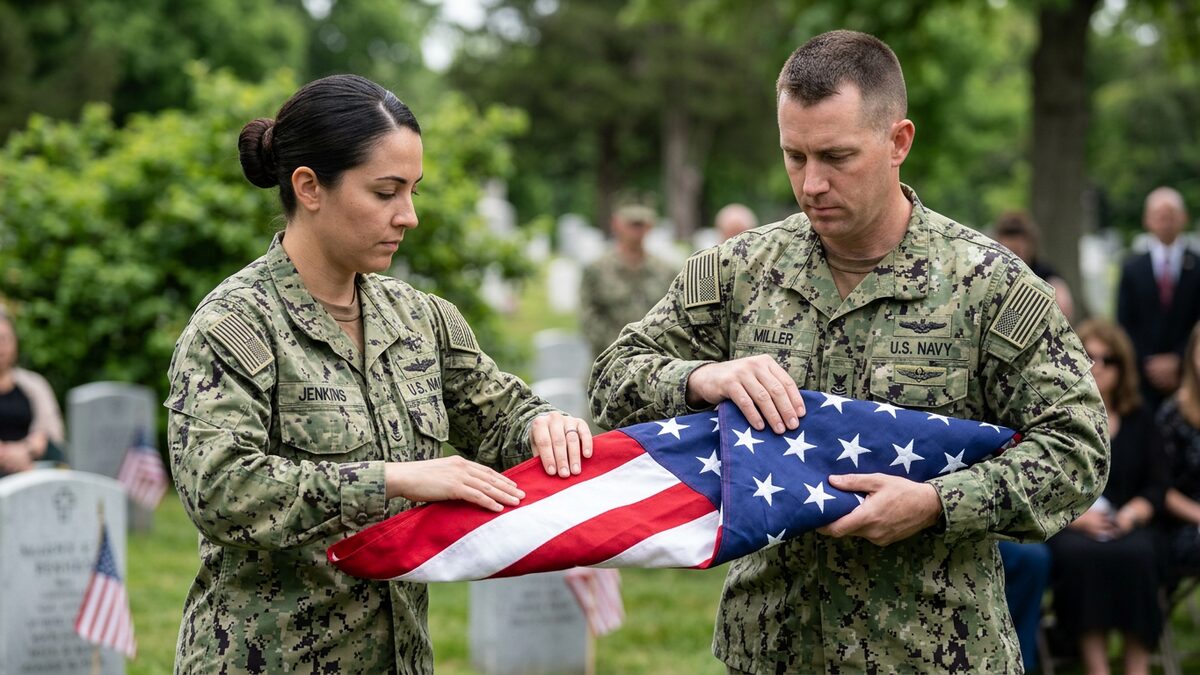
The protocols for folding the American flag during official ceremonies embody more than a procedural task—they symbolize profound respect for the nation’s heritage and the sacrifices of its people. Rooted in military tradition, each precise fold reflects centuries of honor and solemnity, reinforcing the flag’s status as a powerful emblem of unity. Exploring these customs reveals the depth of meaning behind a practice often witnessed but less frequently understood.
Key Takeaways
- The American flag folding protocols originate from military traditions dating back to the Revolutionary War.
- The flag is first folded lengthwise twice, keeping the blue union visible on the outside.
- Larger flags may require a third lengthwise fold before beginning the triangular folding.
- The triangular folding continues by bringing the striped corner to the open edge repeatedly until complete.
Since the early days of the United States, the American flag has served as a powerful symbol of national unity and sacrifice, with its folding protocols tracing back to military traditions established during the Revolutionary War. These carefully prescribed methods, developed to honor the flag’s significance, have become an integral part of official ceremonies, reflecting respect for the nation’s heritage and the solemnity of service. Understanding these protocols offers insight into the enduring reverence with which the flag is treated in formal settings.
Core Folding Sequence
The standard protocol for folding the American flag during official ceremonies begins by fully extending the flag and folding it lengthwise once. This initial fold sets the foundation for subsequent steps. Following this, the flag is folded lengthwise a second time, ensuring that the blue union, or canton, remains visible on the outside. For larger flags, a third lengthwise fold may be necessary before proceeding to the traditional triangular folding. The triangular fold starts by bringing the striped corner of the folded edge to the open edge, and this process continues in successive triangular folds until the flag is fully compacted into a triangle. At the conclusion of this sequence, only the blue field with stars remains visible, symbolizing the unity and vigilance of the nation.
These carefully prescribed methods, developed to honor the flag’s significance, have become an integral part of official ceremonies, reflecting respect for the nation’s heritage and the solemnity of service.
Officially Published Procedure Details
According to the U.S. Army’s Military OneSource brochure, the folding ceremony is ideally performed by two people standing at opposite ends of the flag. They hold the flag waist-high and parallel to the ground to maintain respect and precision. The folding begins by folding the lower half of the striped section over the field of stars. Next, a second lengthwise fold is executed, again ensuring the blue field is displayed outward. The procedure then calls for a series of triangular folds that continue until the flag is completely folded. Care is taken to tuck any hem that protrudes beyond the blue field inside the folds so that no part of the flag appears irregular or exposed. These detailed instructions serve to preserve the flag’s dignity and ensure uniformity across all formal ceremonies.
Final Appearance of the Folded Flag
The culmination of the American Flag Folding Protocols During Official Ceremonies results in a neatly folded triangular shape often described as resembling a cocked (three-corner) hat. This final form is distinctively triangular rather than rectangular or square. The only visible portion of the flag at the end of the folding process is the blue canton adorned with white stars. This presentation is consistent across various authoritative sources, including The American Legion and the Girl Scouts of Wisconsin Southeast, which emphasize that the folded flag should display solely the blue star field. This appearance symbolizes honor and reverence, reflecting the flag’s sacred status in American culture and military tradition.