
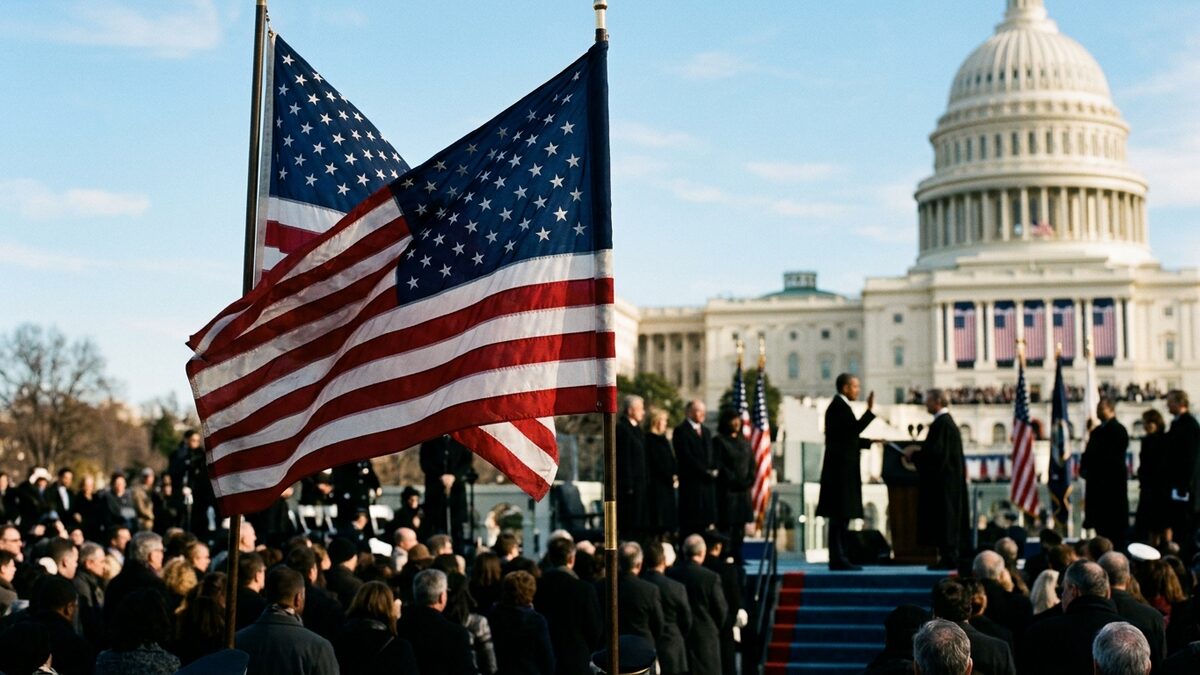
The American flag’s presence at presidential inaugurations serves as a powerful emblem of the nation’s enduring unity and democratic values. From George Washington’s inaugural address to contemporary ceremonies, its symbolism has adapted alongside the country’s evolving political landscape. Exploring the flag’s role reveals deeper insights into how ritual and symbolism intertwine to affirm the peaceful transfer of power and the resilience of American democracy.
Key Takeaways
- The American flag symbolizes national unity and democratic ideals during presidential inaugurations.
- Five large U.S. flags are prominently displayed on the West Front of the U.S. Capitol during the ceremony.
- The central 50-star flag represents the current United States and is flanked by historic flags.
- The Joint Congressional Committee on Inaugural Ceremonies oversees the flag arrangement.
Since George Washington’s first inauguration in 1789, the American flag has stood as a potent emblem of national unity and democratic ideals during presidential ceremonies. Its presence at these events traces the evolving symbolism of the republic, reflecting moments of triumph, crisis, and renewal. As each new administration assumes office beneath its stars and stripes, the flag not only marks the peaceful transfer of power but also reaffirms the enduring principles upon which the United States was founded.
Core Flag Protocol at the Inauguration
The American Flag in Presidential Inauguration Ceremonies serves as a formal and consistent element, integral to the visual and symbolic framework of these events. The current standard arrangement on the West Front of the U.S. Capitol features five large U.S. flags prominently displayed. Central to this display is the modern 50-star flag, representing the present-day United States, positioned at the heart of the inaugural setting. Flanking this central banner are historic flags that link the ceremony to the nation’s origins. This arrangement is carefully overseen by the Joint Congressional Committee on Inaugural Ceremonies (JCCIC), which ensures that the flag display maintains both ceremonial dignity and historical resonance.
Since George Washington’s first inauguration in 1789, the American flag has stood as a potent emblem of national unity and democratic ideals during presidential ceremonies.
In a significant development, a 2025 White House directive mandated that the American flag be flown at full-staff on Inauguration Day and all future inauguration days. This order extends beyond the Capitol, requiring full-staff display at the White House, public buildings, military installations, naval stations, federal vessels, and U.S. facilities abroad. This policy underscores the flag’s role as a unifying national symbol during the peaceful transition of presidential power.
Historic Flag Designs Used in the West Front Display
The American Flag in Presidential Inauguration Ceremonies includes not only the contemporary national flag but also historic designs that evoke the early years of the republic. The flags immediately adjacent to the central 50-star flag are 13-star banners, symbolizing the original colonies that declared independence in 1776. These 13-star flags are often attributed to Francis Hopkinson, a Continental Congress member credited with early flag design contributions. Their inclusion situates the inauguration within the broader narrative of American independence and foundational ideals.
The outermost flags in the five-flag configuration are commonly known as the “Betsy Ross” flags, which are believed to have appeared in the early 1790s. These flags feature a circular arrangement of stars and are emblematic of the fledgling nation’s unity during its formative years. In some inaugurations, such as one referenced in an 1819 program, a 21-star flag was incorporated to acknowledge the president’s home state—in that case, Illinois, which joined the Union in 1818. These historic flags serve not only as ceremonial decorations but also as visual representations of the nation’s growth and evolution.
Meaning of the Flag Layout in Inauguration Visuals
The deliberate layout of the five-flag display at presidential inaugurations carries significant symbolic meaning. The central placement of the current 50-star flag visually anchors the ceremony in the contemporary United States, affirming the nation’s present unity and governmental authority. Surrounding this central symbol are historic flags that connect the event to the country’s founding era, creating a temporal bridge between past and present.
This arrangement reinforces the idea that each presidency is part of an ongoing historical continuum. The older flags evoke the origins of American democracy, while the modern flag embodies the current state of the Union. As noted in a 2001 ABC report, the presence of the historic flags flanking the central banner highlights the inauguration as a moment of renewal grounded in the nation’s foundational principles. Thus, the American Flag in Presidential Inauguration Ceremonies functions not only as a patriotic emblem but also as a visual narrative linking the nation’s heritage to its future trajectory.