
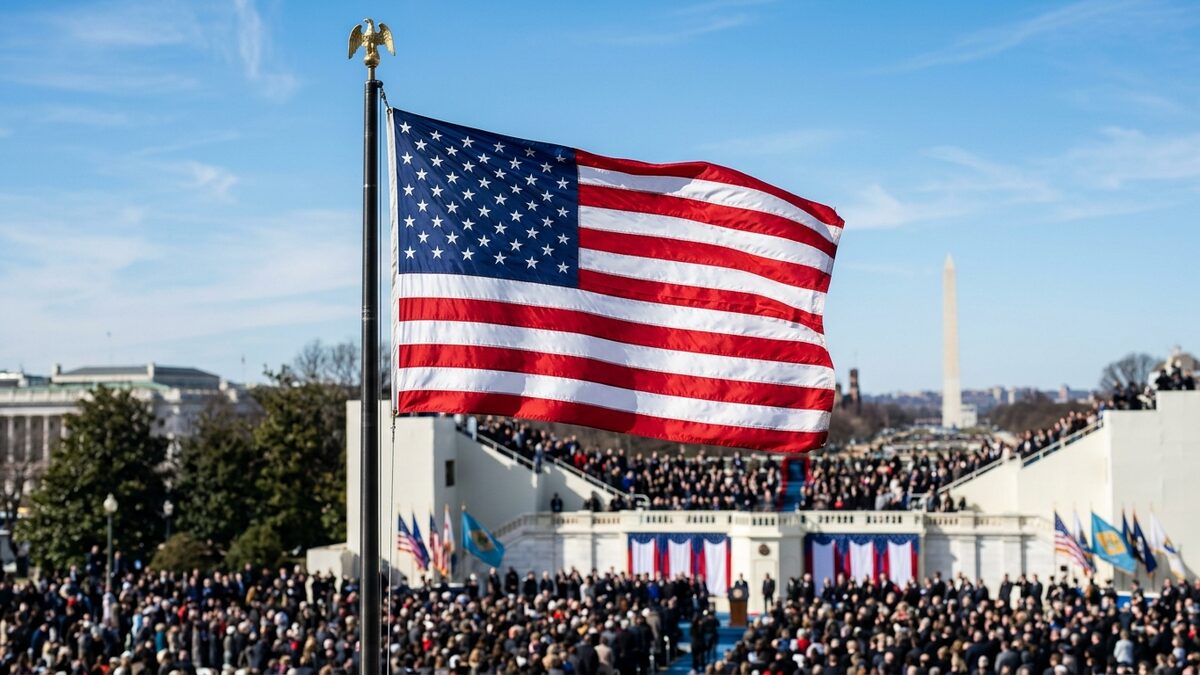
The American flag’s presence at presidential inaugurations has transformed from mere decoration to a powerful symbol of national unity and republican values. Since George Washington’s historic 1789 oath, the flag has underscored the continuity of democratic governance and the resilience of American ideals. Exploring how this emblem has adapted alongside political culture and public sentiment reveals its enduring significance in the ceremonial fabric of the Capitol’s West Front.
Key Takeaways
- The American flag symbolizes national unity and democratic continuity during presidential inaugurations.
- Its display during the oath-taking ceremony reaffirms the nation's founding principles.
- The flag arrangement on the Capitol West Front includes five flags with the 50-star flag in the center.
- Flag traditions at inaugurations reflect changes in political culture and public sentiment.
The American flag has long served as a potent symbol of national unity and democratic continuity, its presence prominently marked during the inauguration of George Washington in 1789, the first organized transfer of presidential power under the Constitution. From that moment, the flag’s display evolved beyond mere decoration to embody the ideals of the republic, framing the solemn oath-taking as both a reaffirmation of the nation’s founding principles and a visual testament to the resilience of American governance. Through successive inaugurations, the flag’s role has reflected shifts in political culture and public sentiment, underscoring its enduring significance as a unifying emblem amid the ceremony’s ritualistic pageantry.
Flag Display Traditions on the Capitol West Front
During every presidential inauguration, the American flag is displayed with precise symbolism on the West Front of the U.S. Capitol. A consistent arrangement of five flags is featured, with the current 50-star flag centrally placed, representing the contemporary union of states. Flanking this center flag are two flags that correspond to the number of stars associated with the President’s home state at the time of its admission to the Union. For instance, during President Donald Trump’s inauguration, these flanking flags displayed 13 stars, reflecting New York’s status as one of the original colonies. The outermost two flags in the arrangement are the historic Betsy Ross flags, which honor the original 13 colonies. This deliberate configuration connects the present to the nation’s origins, framing the inauguration as both a modern political event and a continuation of American historical identity.
The American flag has long served as a potent symbol of national unity and democratic continuity, its presence prominently marked during the inauguration of George Washington in 1789, the first organized transfer of presidential power under the Constitution.
Historical Significance of the 13-Star Betsy Ross Flag
The Betsy Ross flag holds a venerable place in the iconography of American history and is integral to inauguration symbolism. Originating from a design adopted by the Continental Congress in 1777, it features 13 alternating red and white stripes with a circle of 13 white stars on a blue field, each element symbolizing the original colonies. While the precise origins remain debated, Francis Hopkinson is credited with advocating an early official design of the flag, lending it historical legitimacy. The arrangement of the stars in a circle on the Betsy Ross flag is distinct from later variants, such as the Hopkinson flag, which arranged stars in rows. Its presence as the fourth and fifth flags during inaugurations pays homage to the nation’s founding era, visually anchoring the ceremony in the revolutionary ideals that shaped the republic.
Flag Code Regulations for Inauguration and Presidential Death
The display of the American flag during presidential inaugurations is governed by the U.S. Flag Code, which establishes protocols to ensure respect and uniformity. As Inauguration Day is a national holiday, the Flag Code stipulates that the flag “should be displayed” at all federal buildings to mark the occasion. The Code also addresses the flag’s position during periods of mourning: when a president dies, the flag “shall be flown at half-staff” on all federal properties for 30 days. Importantly, if Inauguration Day coincides with this mourning period, the flag must remain at half-staff despite the celebratory nature of the event. This regulation underscores the flag’s role as a symbol not only of national pride but also of collective grief and respect, reflecting the complex interplay between continuity and solemnity in American political rituals.