
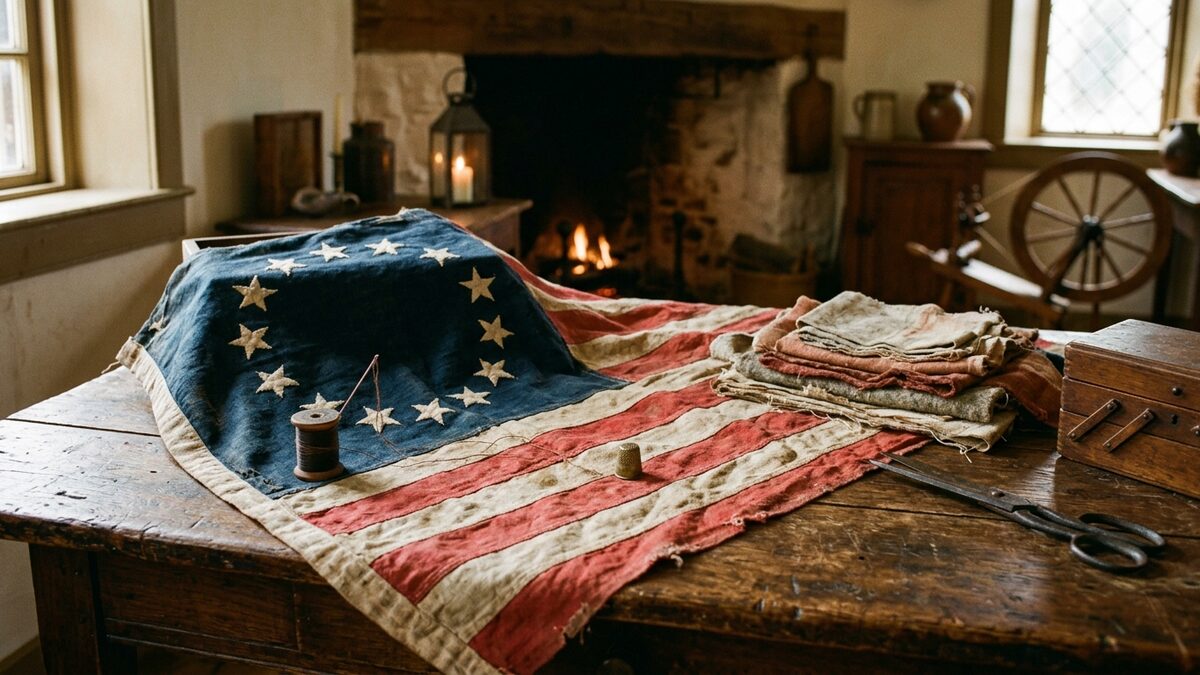
The Betsy Ross flag stands as a powerful emblem of early American identity, embodying unity and resilience during the Revolution. While commonly attributed to Betsy Ross herself, the origins of this iconic thirteen-star banner reveal a complex intertwining of myth and historical narrative. Exploring how this symbol evolved offers insight into the ways national memory and revolutionary iconography have shaped collective understanding of America’s founding.
Key Takeaways
- The Betsy Ross flag symbolizes early American unity during the Revolution.
- The story of Betsy Ross sewing the first flag is more folklore than documented fact.
- The flag's design with thirteen stars and stripes was mandated but not specifically detailed in 1777.
- The circular star pattern became a later patriotic symbol, not originally legislated.
In the tumultuous years of the American Revolution, as the colonies sought to forge a unified identity against British rule, symbols became crucial in rallying support and expressing emerging national ideals. Among these, the thirteen-star flag—commonly attributed to Betsy Ross—has endured as a potent emblem of early American unity and perseverance. While the story of Ross sewing the first flag is deeply embedded in popular folklore, its origins and historical veracity invite closer examination within the broader context of revolutionary iconography and the construction of national memory.
Origins of the Betsy Ross Flag
The flag commonly known as the Betsy Ross flag features thirteen alternating red and white stripes alongside thirteen white stars arranged in a circle on a blue field. This design aligns broadly with the Flag Act passed by the Continental Congress on June 14, 1777, which mandated thirteen stripes and thirteen stars to represent the original colonies but did not specify the precise configuration or pattern of these stars. The circular arrangement of stars, often linked to Ross, emerged later as a patriotic symbol rather than from documented legislative instructions or contemporary practice. Although the thirteen-star flag is widely embraced as a symbol of the American Revolution and early national unity, its exact historical origin remains ambiguous and debated among historians.
While the story of Ross sewing the first flag is deeply embedded in popular folklore, its origins and historical veracity invite closer examination within the broader context of revolutionary iconography and the construction of national memory.
Betsy Ross as a Historical Person
Elizabeth “Betsy” Ross was indeed a Philadelphia upholsterer who lived from 1752 to 1836 and contributed to the revolutionary cause by producing flags, tents, and uniforms for Continental forces and later government agencies. Archival records confirm that she was part of a network of women in Philadelphia engaged in flag-making, reflecting a collaborative rather than singular production of these symbols. Notably, on May 29, 1777, Ross received payment from the Pennsylvania State Navy Board for flag-making services, providing concrete evidence of her involvement in this trade. However, the documented work of Ross as a flagmaker does not directly verify the claim that she crafted the first official American flag; this remains a separate and more contentious aspect of her legacy.
The Famous “First Flag” Story and Its Place in American Folklore
The narrative that George Washington and other Founding Fathers personally commissioned Betsy Ross to sew the first American flag in Philadelphia is a story that only surfaced publicly in 1870, when Ross’s grandson, William Canby, recounted it. Despite its popularity, historians have found no contemporaneous evidence—such as letters, diaries, or official congressional records—that confirms this episode. The Smithsonian Institution and other scholarly sources emphasize that the story gained traction primarily during the nation’s centennial celebrations in 1876, a period when patriotic mythology was actively constructed to foster national identity. Consequently, the tale of Betsy Ross sewing the first flag is widely regarded as a legend, one that has been perpetuated more through cultural memory and patriotic symbolism than through verifiable historical documentation.