
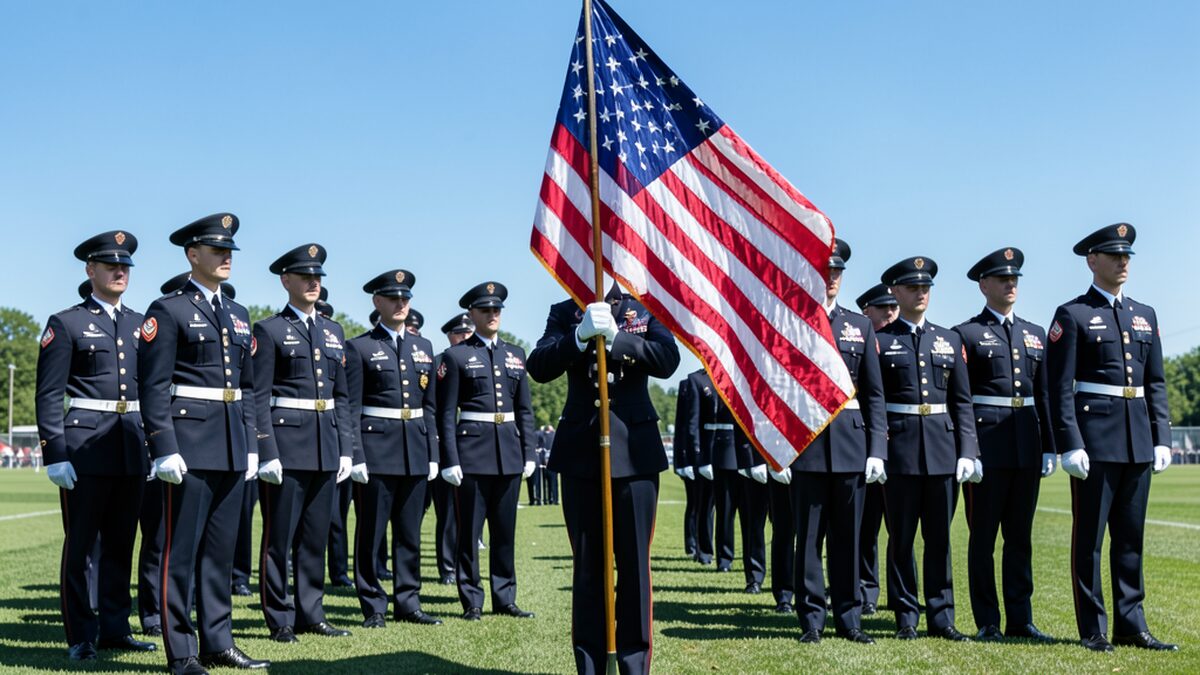
The American flag’s role in military ceremonies extends beyond symbolism, embodying a profound connection to the nation’s history and values. From its origins in the Revolutionary War to contemporary rituals, the flag serves as a unifying emblem of sacrifice and patriotism. Exploring how these ceremonies maintain this legacy reveals the enduring significance of the flag in honoring those who serve and preserving the spirit of American identity.
Key Takeaways
- The American flag symbolizes national identity and military valor since 1777.
- Military ceremonies use the flag to honor sacrifice, unity, and patriotism.
- The United States Flag Code provides guidelines for respectful flag display in ceremonies.
- Flag traditions link modern military rituals to America's historical military heritage.
Since the Continental Congress first authorized the creation of a distinct banner for the fledgling United States in 1777, the American flag has served as a potent symbol of national identity and military valor. Throughout the Revolutionary War, the flag was not merely a marker on the battlefield but a rallying point for troops forging a new nation. This tradition of symbolic significance has endured, evolving into formalized ceremonial practices within the armed forces that honor sacrifice, unity, and patriotism. The use of the American flag in military ceremonies thus embodies a continuum of historical meaning, linking contemporary rituals to the origins of American military heritage.
Legal Basis and Official Authority
The use of the American flag in military ceremonies is governed primarily by the United States Flag Code, codified at 4 U.S.C. Chapter 1. This legal framework establishes the standards for respectful treatment and display of the flag, emphasizing that “no disrespect should be shown” to the national emblem. Although the Flag Code itself is advisory rather than strictly enforceable by law, it serves as the foundational guideline for military ceremonial protocol and is widely adopted by veterans’ organizations and federal agencies.
Since the Continental Congress first authorized the creation of a distinct banner for the fledgling United States in 1777, the American flag has served as a potent symbol of national identity and military valor.
Within the armed forces, branches such as the U.S. Army publish detailed flag-display guidance that reinforces the Flag Code’s principles, specifying the flag’s proper placement and precedence in official settings. Similarly, Veterans Affairs-affiliated institutions and organizations like The American Legion consistently reference the Flag Code to maintain uniformity in ceremonial practices. This legal and regulatory framework underscores the flag’s role as a symbol of national unity and military honor, ensuring its ceremonial use reflects the reverence accorded to those who serve under it.
Saluting during Hoisting, Lowering, and Parade Movement
Saluting protocols surrounding the use of the American flag in military ceremonies are rigorously defined to express respect and patriotism. When the flag is hoisted or lowered, all uniformed personnel are required to render the military salute. Civilians and non-uniformed individuals demonstrate respect by facing the flag and standing at attention with the right hand placed over the heart. Those wearing headdresses who are not in uniform are instructed to remove them with the right hand and hold them over the left shoulder while placing the right hand over the heart.
Salutes are also mandated during the passing of the flag in parades or formal reviews, including when it is part of a moving column. Veterans and active-duty members not in uniform are permitted and encouraged to render the military salute during these occasions, reinforcing the flag’s role as a symbol that transcends active service status. These detailed protocols ensure that the flag remains a focal point of honor and unity during military ceremonies, reinforcing the collective respect owed to it.
Flag Raising, Lowering, and Retreat/Reveille Practices
Military ceremonial practices dictate that the American flag should be hoisted briskly and lowered with deliberate solemnity. This contrast in movement underscores the flag’s significance, with the brisk raising symbolizing readiness and the ceremonious lowering reflecting reverence and closure. When flown at half-staff to signify mourning, the flag is first raised to the peak before being lowered to half-staff, and before being taken down for the day, it is again raised to the peak to complete the ritual.
The ceremonies of retreat and reveille further exemplify the flag’s centrality in daily military tradition. Retreat involves the lowering and careful folding of the flag at sunset, serving as a tribute to the nation and its armed forces. The following morning, the reveille ceremony raises the flag again, symbolizing renewal and the continuation of duty. These practices reflect a deeply ingrained respect for the flag and its embodiment of the values and sacrifices associated with military service.