
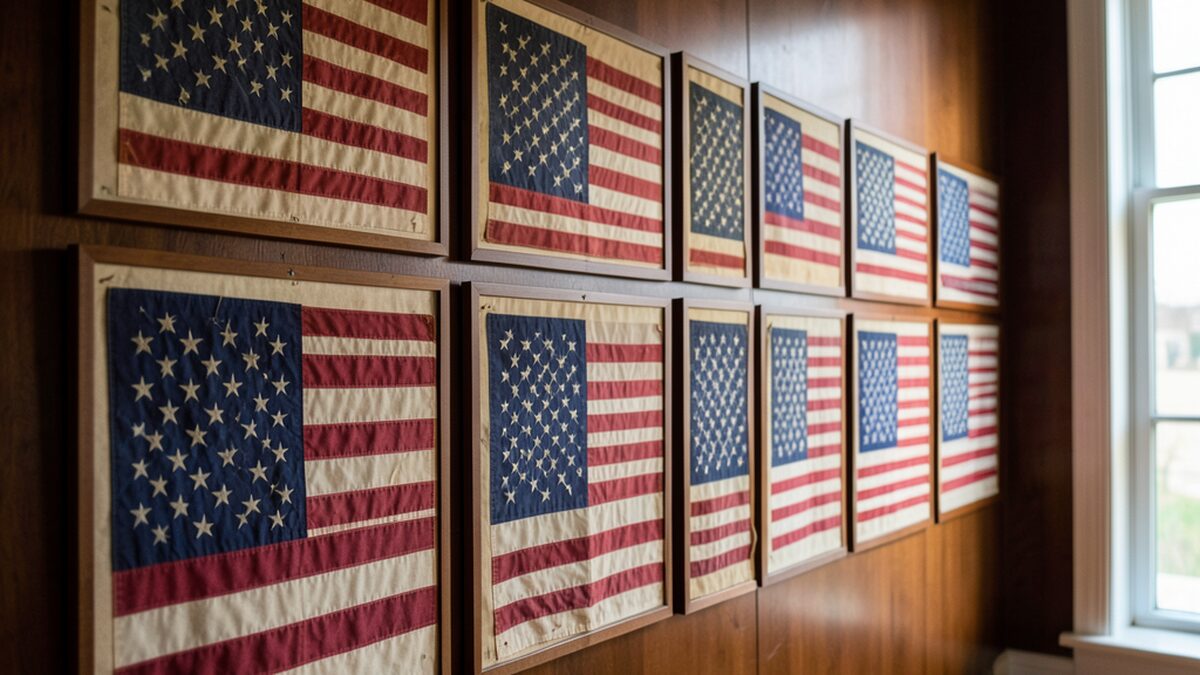
The evolution of the American flag’s star arrangement since 1912 offers a unique lens into the nation’s growth and identity. Each modification not only marks the addition of new states but also reflects broader historical and political contexts. By examining the balance between symbolism, design aesthetics, and production challenges, this article reveals the complex story behind a familiar national icon, inviting a deeper appreciation of its dynamic transformation over time.
Key Takeaways
- The American flag’s star arrangement has changed multiple times since 1912 to reflect new states joining the Union.
- Before 1912, there was no official standard for star placement, resulting in diverse and varied designs.
- Changes to the star pattern balance symbolism, aesthetics, and practical manufacturing considerations.
- Each redesign marks a historical milestone tied to territorial expansion and statehood.
Since the admission of New Mexico and Arizona into the Union in 1912, the American flag has undergone several alterations to its star arrangement, reflecting the nation’s evolving composition. Each adjustment to the flag’s constellation of stars marks a specific historical juncture, encapsulating territorial expansion, statehood milestones, and shifting political realities. This article traces the chronological progression of these modifications, examining how the flag’s star pattern has been redesigned to accommodate new states while balancing symbolism, aesthetics, and manufacturing practicalities over more than a century.
Pre-1912 Star Arrangement Variations
Prior to the formalization of the star arrangement in 1912, the American flag exhibited significant variation in the placement of its stars. Throughout the 19th century, no official standard dictated star configuration, leading to a range of designs including rectangular grids, circular patterns, and staggered rows. These arrangements often depended on individual flag makers’ preferences or the intended use of the flag. For example, the 46-star flag introduced after Oklahoma’s admission in 1907 commonly displayed an 8-7-8-8-7-8 pattern, while the 45-star flag for Utah (1896–1908) adopted an 8-7-8-7-8-7 layout. Although the U.S. Army and Navy maintained some standardized designs, civilian flags continued to show diverse star patterns, resulting in a lack of uniformity across the nation’s banners.
Each adjustment to the flag’s constellation of stars marks a specific historical juncture, encapsulating territorial expansion, statehood milestones, and shifting political realities.
1912 Executive Order Establishing 48-Star Flag
The first significant standardization of the flag’s star arrangement came with President William Howard Taft’s Executive Order on June 24, 1912. This directive officially prescribed a 48-star flag configuration following the admission of New Mexico and Arizona earlier that year, which brought the total number of states to 48. The order specified that the stars be arranged in six horizontal rows of eight stars each, with each star oriented so that a single point faced upward. This design marked the first time the U.S. government mandated a precise star pattern, ending the previous era of varied civilian designs. Alongside the star layout, the order established flag proportions at a ratio of 1:1.9 (hoist to fly), providing a comprehensive standard for both the flag’s shape and its constellation of stars.
Duration and Stability of 48-Star Design
The 48-star flag design proved remarkably durable, remaining the official flag of the United States from July 4, 1912, until July 3, 1959—a span of 47 years. This period saw no changes to the number of states, as no additions occurred between Arizona’s admission in 1912 and Alaska’s entry in 1959. Consequently, the six-by-eight star grid established by Taft’s executive order maintained its relevance without alteration. The 48-star flag became the longest-serving official design in U.S. history until surpassed by the 50-star flag, introduced in 1960. Despite the adoption of new flags after 1959, many businesses, government agencies, and individuals continued to use the familiar 48-star version for several years, underscoring its enduring symbolic and practical significance.