
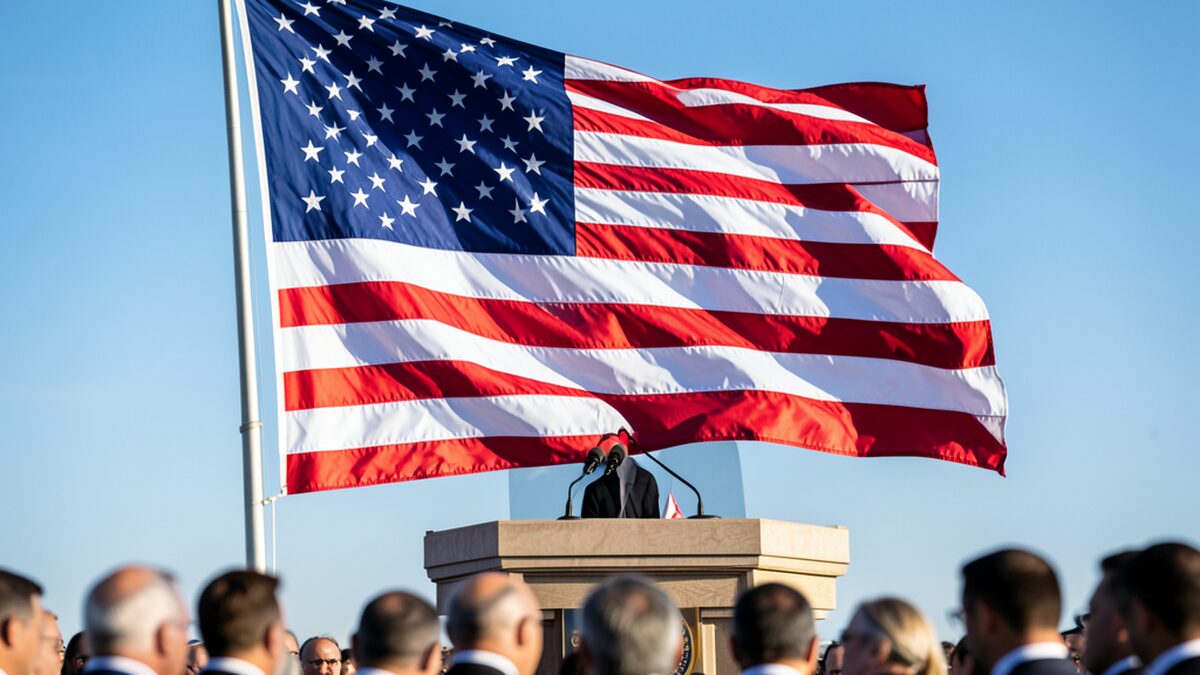
The American flag’s prominent presence at presidential inaugurations offers a compelling lens through which to examine the nation’s evolving political identity and enduring values. From George Washington’s historic oath to modern ceremonies, the flag symbolizes continuity, patriotism, and the peaceful transfer of power. Exploring its role reveals deeper insights into how this emblem unites the country during pivotal moments of leadership transition.
Key Takeaways
- The American flag has symbolized national unity and identity since the first presidential inauguration in 1789.
- Its presence at inaugurations reflects the peaceful transfer of power and the continuity of the republic.
- The flag is prominently displayed at the Capitol and the inaugural platform during ceremonies.
- The Joint Congressional Committee on Inaugural Ceremonies oversees the flag’s role in the official inauguration staging.
Since George Washington’s first inauguration in 1789, the American flag has stood as a potent emblem of national identity and unity during presidential inaugurations. Raised amid the fledgling republic’s hopes and uncertainties, the flag’s presence at these ceremonies has evolved alongside the nation itself, symbolizing continuity, patriotism, and the peaceful transfer of power. Examining its role reveals not only changing political contexts but also the enduring power of this emblem to embody the ideals and aspirations of the United States as each president takes the oath of office.
Official Ceremonial Use at the Inauguration
The American flag serves as a central visual element in U.S. presidential inaugurations, prominently displayed at the Capitol and on the inaugural platform. The Joint Congressional Committee on Inaugural Ceremonies (JCCIC), composed of members from both the House of Representatives and the Senate, is responsible for planning the official ceremony and platform design. The committee ensures that the flag’s presence is integral to the patriotic staging that frames the swearing-in, podium, and audience areas, reinforcing the gravity and symbolism of the event.
Since George Washington’s first inauguration in 1789, the American flag has stood as a potent emblem of national identity and unity during presidential inaugurations.
Large U.S. flags are strategically used as backdrops, centering attention on the president-elect during the oath of office. This arrangement is carefully crafted for both the live audience and television viewers, emphasizing the flag’s role as a unifying national symbol. The flag’s visual prominence underscores the inauguration as a moment of national significance, linking the individual assuming office to the broader ideals of the republic.
The Standard Flag Arrangement on the Capitol’s West Front
The west front inaugural platform has developed a recognizable and standardized flag arrangement that features five large U.S. flags. The centerpiece is the current 50-star flag, symbolizing the contemporary United States. Flanking this central flag are two earlier flag designs, creating a symmetrical and historically resonant tableau. The outermost pair of flags is often the 13-star “Betsy Ross” style flag, evoking the nation’s origins.
This arrangement visually narrates the evolution of the American flag alongside the nation’s history, linking the present with the past in a ceremonial context. The consistent use of this configuration in modern inaugurations reflects an established tradition that situates the president-elect within a continuum of American governance and identity.
Home-State and Historical Flag Symbolism
In addition to the standardized flag display, a notable modern practice involves incorporating a flag associated with the incoming president’s home state. Since the early 1990s, this often includes the flag that was official when the president’s home state joined the Union. This practice adds a personalized historical dimension to the inauguration, connecting the new administration to both state and national heritage.
For example, George H. W. Bush’s 1989 inauguration featured a 38-star flag, referencing the nation’s Centennial era of 1876. Such historical flag selections have been described as embodying a “from George Washington to George Bush” style sequence, symbolizing continuity across presidential administrations. This layered symbolism reinforces the American flag’s role in inaugurations as not only a national emblem but also a marker of historical context and political lineage.