
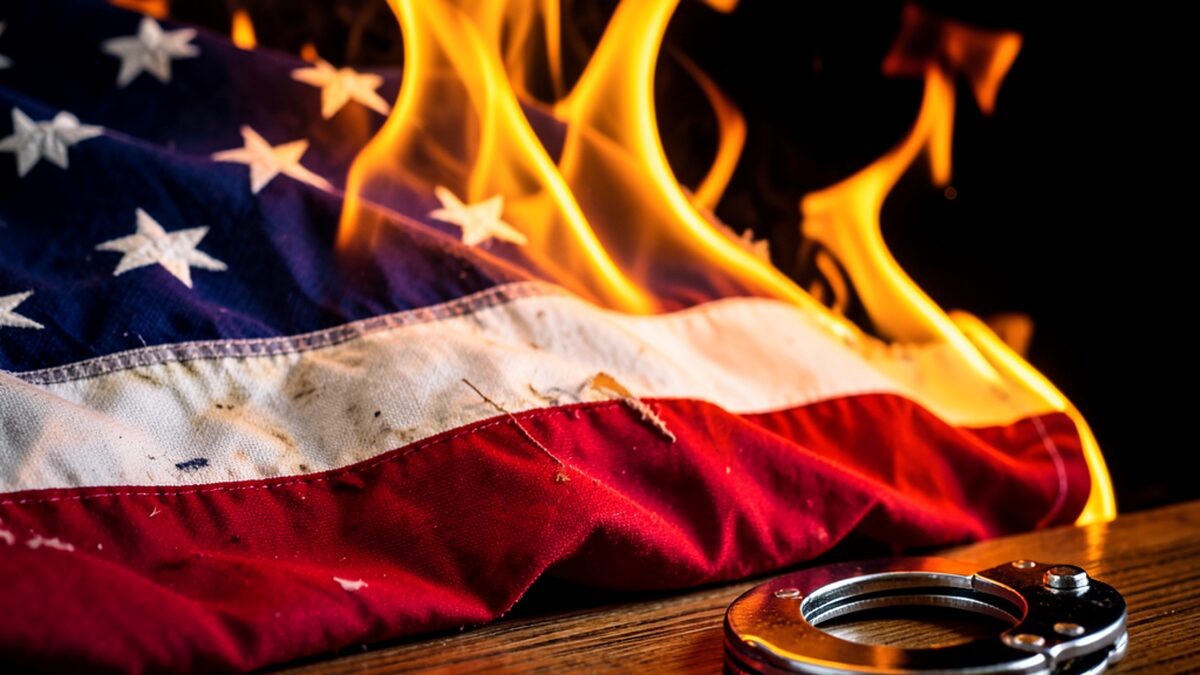
The act of flag burning, while relatively rare, consistently ignites complex legal disputes that pit state criminal statutes against First Amendment protections. Over the past three decades, numerous prosecutions have tested the boundaries of free speech and governmental authority. This article examines pivotal Supreme Court decisions and statutory frameworks that shape the contentious legal environment surrounding flag desecration, raising critical questions about constitutional rights and societal values.
Key Takeaways
- Flag burning is legally recognized as symbolic speech protected by the First Amendment.
- More than 200 flag burning cases have led to criminal prosecutions in the U.S. over the last 30 years.
- The Supreme Court’s decision in Texas v. Johnson set a key precedent limiting government restrictions on flag burning.
- State laws on flag burning vary, creating ongoing constitutional debates and legal challenges.
Over the past three decades, more than 200 documented incidents of flag burning have resulted in criminal prosecution across the United States, underscoring the persistent legal controversy surrounding this act. Despite its relatively infrequent occurrence compared to other forms of protest, flag burning continues to provoke intense legal scrutiny due to its complex intersection with First Amendment protections and state-level statutes. This article examines the legal implications of flag burning under U.S. law, analyzing key judicial decisions, statutory frameworks, and constitutional debates that shape its contested status.
Supreme Court Baseline: Flag Burning as Protected Expression
The landmark decision in Texas v. Johnson, 491 U.S. 397 (1989), established a critical constitutional precedent by affirming that flag burning constitutes symbolic speech protected under the First Amendment. In a narrow 5–4 ruling, the Supreme Court overturned Gregory Lee Johnson’s conviction for burning the American flag during a political demonstration at the 1984 Republican National Convention in Dallas, Texas. The Court emphasized that the government’s interest in preserving the flag as a symbol did not justify criminalizing expressive conduct, as such regulation would suppress dissenting political expression.
The landmark decision in Texas v. Johnson, 491 U.S. 397 (1989), established a critical constitutional precedent by affirming that flag burning constitutes symbolic speech protected under the First Amendment.
This ruling remains the touchstone for evaluating the legality of flag burning in the United States. It confirms that political flag burning, when conducted as a form of protest, generally enjoys constitutional protection. Consequently, state and local statutes criminalizing flag desecration must be scrutinized under the First Amendment to avoid impermissible restrictions on free speech.
Federal Statute: 18 U.S.C. § 700
Federal law addressing flag desecration is codified in 18 U.S.C. § 700, which criminalizes knowingly mutilating, defacing, physically defiling, burning, maintaining on the floor or ground, or trampling upon a U.S. flag, with penalties including fines and imprisonment for up to one year. The statute explicitly exempts the proper disposal of worn or soiled flags, reflecting a limited allowance for respectful handling consistent with flag etiquette. This provision underwent amendments in 1989, coinciding with the evolving judicial landscape on flag desecration.
Despite its explicit prohibitions, the enforcement and constitutionality of 18 U.S.C. § 700 are constrained by the Supreme Court’s rulings in Texas v. Johnson and subsequent decisions. The statute’s broad ban on flag desecration, without differentiating between expressive and non-expressive conduct, raises significant First Amendment concerns. Courts have generally interpreted the statute narrowly to avoid infringing on constitutionally protected expressive conduct, thereby limiting its practical reach in prosecuting political flag burning.
Federal Constitutional Follow-Up: The Flag Protection Act
In response to the Texas v. Johnson decision, Congress enacted the Flag Protection Act of 1989, aiming to criminalize flag desecration while attempting to sidestep First Amendment challenges. However, the Supreme Court invalidated this legislation in United States v. Eichman, 496 U.S. 310 (1990), holding that the Act’s restrictions targeted expressive conduct and thus violated the First Amendment. The Court reaffirmed that the government could not prohibit flag burning simply because it disapproved of the message conveyed.
This sequence of decisions firmly establishes that federal attempts to broadly criminalize flag desecration must yield to constitutional free speech protections. The legal implications of flag burning under U.S. law remain dominated by these precedents, underscoring the primacy of expressive rights even in the context of symbols imbued with national significance.