
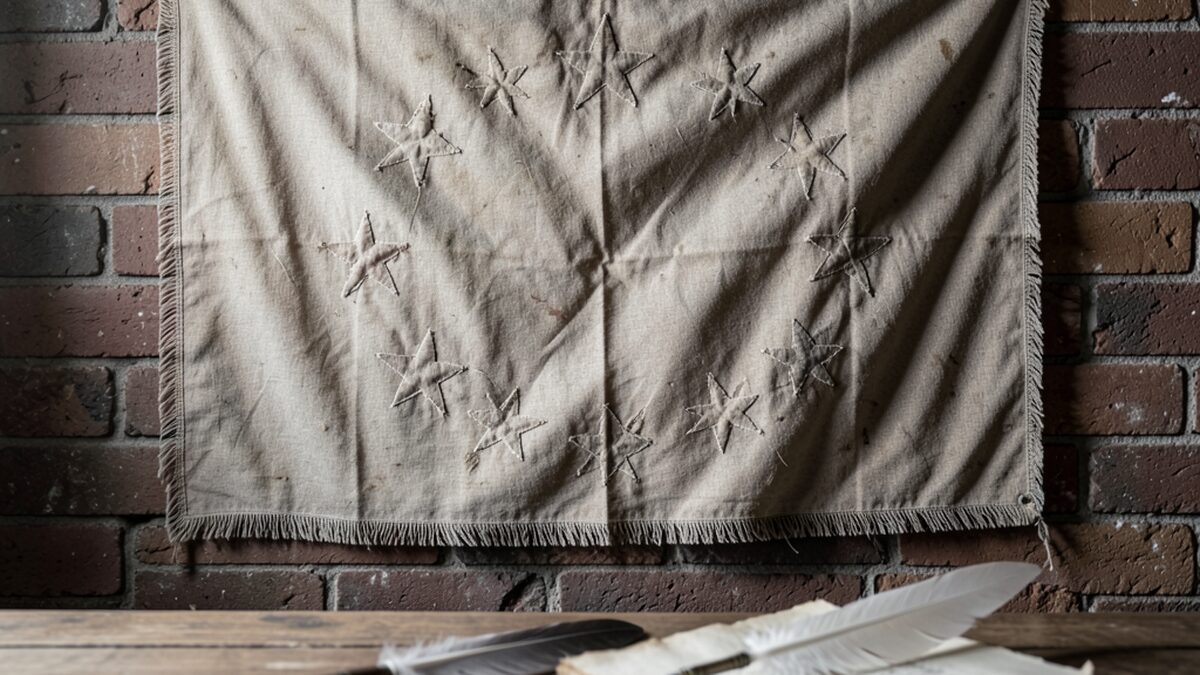
The narrative of Betsy Ross creating the first American flag endures as a potent emblem of unity, yet its authenticity faces scrutiny from historians. This article explores the tension between popular myth and documented history, urging a critical examination of primary sources and Revolutionary War context. It raises compelling questions about how national symbols are shaped by both fact and folklore, inviting a deeper understanding of America’s foundational stories.
Key Takeaways
- The story of Betsy Ross sewing the first American flag is largely based on legend rather than solid historical evidence.
- The distinctive circle of thirteen stars on the flag symbolizes unity among the original colonies.
- Historians debate the accuracy of Ross’s involvement and the flag’s design due to limited primary sources.
- The Betsy Ross flag serves more as a powerful national symbol than a verified historical artifact.
Did Betsy Ross truly sew the first American flag, or has this enduring image been shaped more by legend than by documented fact? The story of the Betsy Ross flag, with its distinctive thirteen stars arranged in a circle, has become a powerful symbol of American origins and unity. Yet historians have long debated the veracity of this narrative, questioning the evidence supporting Ross’s role and the flag’s design. Exploring the origins of the flag requires scrutinizing primary sources, evaluating the context of Revolutionary War iconography, and distinguishing myth from history in the formation of national identity.
The Betsy Ross Flag Legend
The legend surrounding Betsy Ross claims that in June 1776, Betsy Ross, a Philadelphia upholsterer, crafted the first American flag. According to this narrative, George Washington, Robert Morris, and George Ross visited her with a rough sketch of the flag’s design. A pivotal element of the story is Betsy Ross’s suggestion to use five-pointed stars instead of the previously considered six-pointed stars, a choice that has become emblematic in the flag’s iconography. The flag itself, commonly referred to as the “Betsy Ross flag,” features thirteen stars arranged in a circle, paired with thirteen alternating red and white stripes, symbolizing the original thirteen colonies. This tale positions Ross as a direct participant in creating the nation’s first official flag, embedding her figure deeply in American Revolutionary lore.
The story of the Betsy Ross flag, with its distinctive thirteen stars arranged in a circle, has become a powerful symbol of American origins and unity.
Historical Scrutiny and Skepticism
Despite its popularity, the Betsy Ross story faces significant skepticism from historians due to a lack of contemporary evidence. No records from the Revolutionary era mention Ross’s involvement or the existence of a congressional flag committee as described in the legend. Moreover, George Washington’s purported role in the committee is problematic since he was not a member of Congress, which complicates the narrative’s credibility. The earliest known public recounting of the story appeared nearly a century after the Revolutionary War, further weakening claims of its authenticity. Modern historical assessments generally regard the legend as unverified and likely apocryphal, suggesting that while the Betsy Ross flag design is iconic, its origins are more mythic than factual.
William Canby and the Emergence of the Legend
The primary source of the Betsy Ross flag legend is William Canby, Ross’s grandson, who publicly shared the story in 1870. Canby presented a paper titled “The History of the Flag of the United States” to the Historical Society of Pennsylvania, recounting that he had heard the story directly from Ross herself. However, Canby offered no documentary evidence to substantiate the account. His presentation is the foundation upon which the classic Betsy Ross narrative rests, and it was this publication that significantly contributed to the story’s rise in popularity. The timing of the story’s emergence—almost a century after the Revolution—raises questions about its historical accuracy and the role of family tradition and patriotic sentiment in shaping national memory.