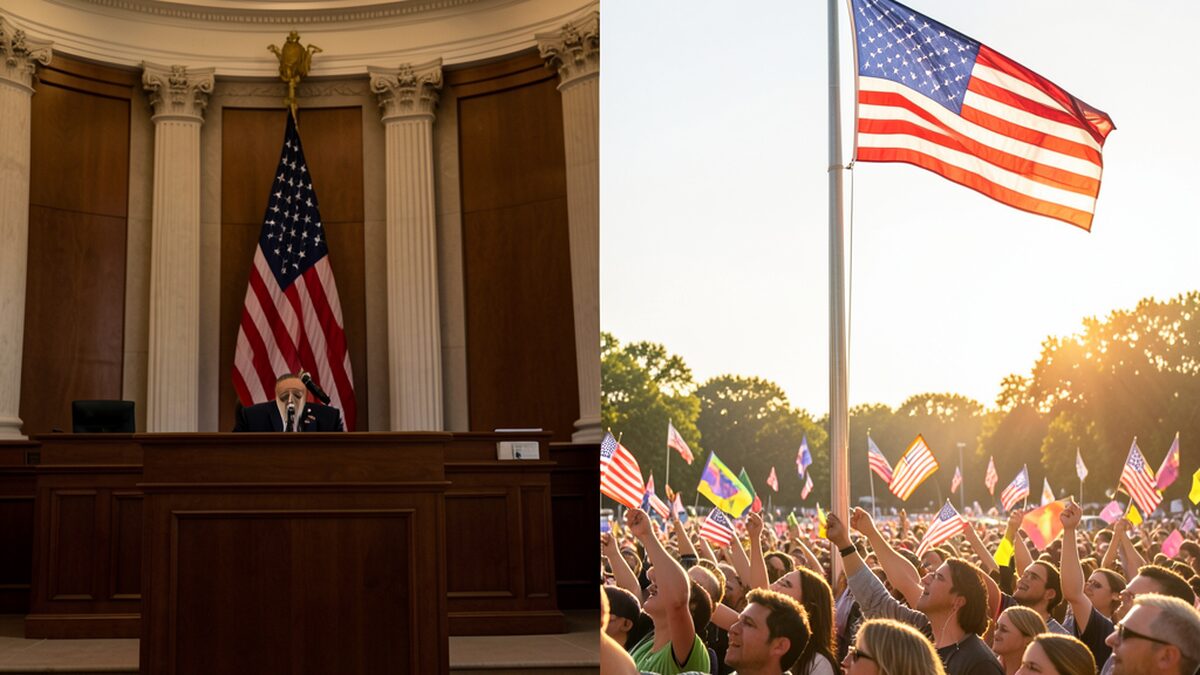
The American flag serves as a powerful emblem of national identity, yet its treatment within Congressional sessions starkly contrasts with its display at public events. This divergence highlights the flag’s dual role: as a symbol of legislative authority governed by strict protocols and as a versatile expression of popular patriotism. Exploring these differences offers insight into how the flag embodies both institutional solemnity and collective unity in American society.
Key Takeaways
- The American flag symbolizes national identity and unity since 1777.
- Congressional sessions follow strict protocols for flag display emphasizing legislative authority.
- Public events showcase the flag as a flexible emblem of popular patriotism.
- The U.S. Flag Code legally governs flag treatment, binding federal institutions but advisory for civilians.
Since its adoption in 1777, the American flag has symbolized national identity, unity, and the values enshrined in the Constitution. Over centuries, its display and treatment have evolved, reflecting shifts in political culture and public sentiment. In the context of Congressional sessions, the flag assumes a formal, institutional role governed by strict protocols that underscore legislative solemnity and authority. Conversely, at public events, the flag often serves as a dynamic emblem of popular patriotism, subject to diverse interpretations and practices. This divergence highlights the complex relationship between the flag’s symbolic meaning within the corridors of power and its role as a unifying icon among the citizenry.
The Legal Framework Governing Flag Display
The foundational legal baseline for the treatment of the American flag is established by the U.S. Flag Code, codified in 4 U.S.C. Chapter 1. This code sets forth a comprehensive set of guidelines regarding the proper display, handling, and etiquette of the flag. While the Flag Code is advisory for civilians, it carries binding authority for federal entities, including Congress, thus institutionalizing flag protocols within government operations. Among its provisions, the code mandates that the flag be displayed daily on or near the main administration building of every public institution, reinforcing the flag’s status as a continuous emblem of national presence.
This divergence highlights the complex relationship between the flag’s symbolic meaning within the corridors of power and its role as a unifying icon among the citizenry.
Moreover, the Flag Code specifies circumstances for flying the flag at half-staff, such as upon the deaths of the President, former Presidents, Vice President, Chief Justice, and Members of Congress, with designated durations reflective of each office’s stature. The American Legion and other patriotic organizations emphasize the Flag Code’s dual role in prescribing both physical display rules—such as speaker-platform placement—and broader etiquette principles. Congressional research services have also underscored that flag regulations are subject to formal legal and policy considerations, situating the flag within a framework of governmental respect and solemnity rather than mere custom.
Institutionalized Flag Protocols in Congressional Sessions
Within Congressional sessions, the treatment of the American flag is characterized by strict adherence to standardized, institutional protocols that emphasize the flag’s symbolic connection to legislative authority and governance. The Flag Code requires that when the flag is displayed on a speaker’s platform, it must be positioned above and behind the speaker if hung flat, thereby visually asserting the flag’s primacy and the legislative body’s allegiance to national ideals. If the flag is mounted on a staff in settings such as a church or public auditorium, it is placed to the speaker’s right side, a position denoting superior prominence in official ceremonies.
Additional rules govern the placement of other flags when displayed alongside the American flag, which must be positioned to the left of the clergyman or speaker or to the right of the audience, ensuring the U.S. flag maintains its foremost position. The Veterans of Foreign Wars (VFW) reiterate these guidelines, underscoring their consistency across federal and veteran-related ceremonial contexts. Furthermore, the Flag Code permits the use of red, white, and blue bunting to adorn speaker’s desks and the fronts of platforms, a common feature in Congressional events that reinforces the flag’s role as a central ceremonial element.
Variability in Flag Treatment at Public Events
In contrast to the regimented protocols observed in Congressional sessions, the treatment of the American flag at public events often exhibits greater variability, reflecting a more spontaneous and popular form of patriotism. Public displays of the flag may range from formal ceremonies—such as Memorial Day services or Independence Day celebrations—to informal gatherings where the flag serves as a unifying emblem for diverse audiences. The Flag Code continues to provide guidance for these occasions; however, enforcement is largely voluntary, permitting citizens and organizers latitude in how the flag is displayed and honored.
This flexibility allows for a broader spectrum of flag-related practices, including the use of the flag in parades, sporting events, and community festivals, where the display may be less rigid but no less meaningful. The flag’s treatment in such contexts often reflects local traditions, cultural expressions, and varying levels of knowledge about official protocols. Consequently, while the flag remains a potent symbol of national identity, its public treatment is more dynamic and subject to interpretation, contrasting with the formal and uniform approach mandated within the halls of Congress.