
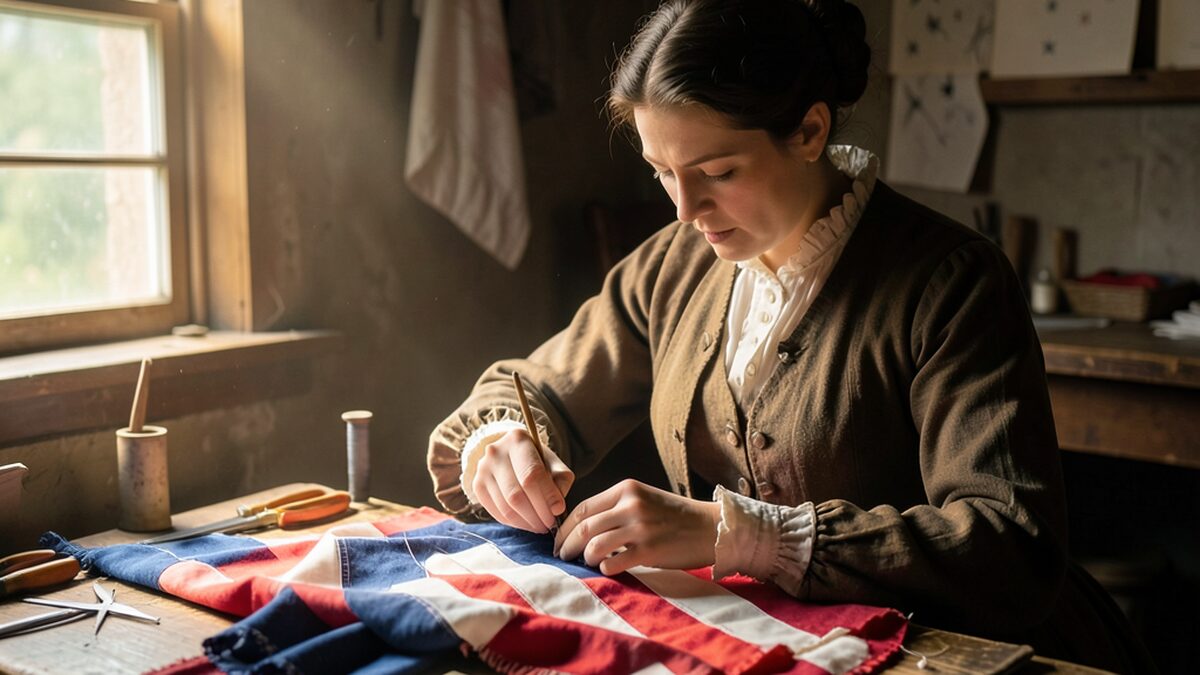
The widely accepted narrative of Betsy Ross as the creator of the first American flag plays a significant role in American cultural identity. Despite its prominence, this story is primarily supported by family tradition rather than solid historical documentation. Exploring the origins and impact of this claim reveals how folklore can influence national memory and raises important questions about the intersection of history, myth, and legacy.
Key Takeaways
- Betsy Ross is popularly credited with sewing the first American flag in 1776.
- Her design reportedly included five-pointed stars instead of six-pointed ones for practicality.
- The story is based largely on family lore and lacks strong contemporary evidence.
- The image of Ross sewing the flag remains a powerful symbol of American unity and independence.
In a small Philadelphia upholstery shop, a modest woman named Betsy Ross is said to have carefully stitched the stars and stripes that would become the emblem of a nascent nation. According to family lore, it was in 1776 that Ross, responding to a request from George Washington and other members of a secret committee, crafted the first American flag, its design symbolizing unity and independence. This vivid image of Ross at her sewing frame has endured, anchoring her legacy in the popular imagination despite limited contemporary documentation.
What the Betsy Ross Story Claims
The legend surrounding Betsy Ross and the first American flag design asserts that in 1776, George Washington, Robert Morris, and George Ross personally approached Elizabeth Griscom “Betsy” Ross in her Philadelphia upholstery shop. They reportedly presented a flag design featuring thirteen alternating red and white stripes and thirteen six-pointed stars arranged on a blue field. According to the story, Betsy Ross suggested that the stars be five-pointed instead of six-pointed, a practical modification she could quickly demonstrate by cutting a five-pointed star in a single snip of her scissors. This narrative positions Ross not only as the flag’s maker but also as an innovator of its iconic star pattern, a symbol that endures in the American flag today.
According to family lore, it was in 1776 that Ross, responding to a request from George Washington and other members of a secret committee, crafted the first American flag, its design symbolizing unity and independence.
The story’s emphasis on her role as the seamstress of the “first official” American flag has been a central element in the popular understanding of the flag’s origins. It casts Ross as a patriotic figure whose contribution to American independence was both tangible and symbolic. However, this account is primarily derived from oral family tradition rather than contemporary records, which complicates its historical verification.
Why the Story Became Famous
The Betsy Ross narrative gained public attention nearly a century after the supposed events. In 1870, her grandson William J. Canby presented the story to the Historical Society of Pennsylvania, claiming to have heard it from family members, including Ross’s daughter. Canby described a secret meeting in Ross’s Philadelphia upholstery shop where the flag was designed and sewn. This presentation marked the first formal public introduction of the story and led to its dissemination through newspapers and magazines, embedding it in American folklore.
The legend’s popularity surged when Harper’s Weekly reiterated Canby’s account as fact in 1873, lending it significant credibility among the public. Despite the story emerging more than ninety years after 1776, it resonated deeply with a post-Civil War America eager for unifying national symbols. The narrative’s appeal was strengthened by its personal, relatable elements—a female artisan contributing to the nation’s founding—helping it to become a foundational myth in the story of Betsy Ross and the first American flag design.
What Official and Scholarly Sources Say
Despite its widespread acceptance in popular culture, the Betsy Ross story has been met with skepticism by historians and official institutions. The National Archives Foundation states that Ross “almost certainly did not sew the first U.S. flag,” highlighting the absence of any contemporary documentation. Similarly, the National Postal Museum notes that extensive searches of diaries, letters, and journals of the Continental Congress have failed to verify Canby’s claims. These sources emphasize that the story is unsupported by primary evidence from the period.
The American Battlefield Trust acknowledges the lack of conclusive evidence either confirming or denying Ross’s role, while Colonial Williamsburg concedes that “we probably will never know who made the first flag.” Collectively, these assessments reflect a scholarly consensus that the Betsy Ross narrative is best understood as legend rather than documented history. Although it plays a significant role in American cultural memory, the story remains outside the realm of verifiable fact, underscoring the complex interplay between myth and history in the origins of the American flag.