
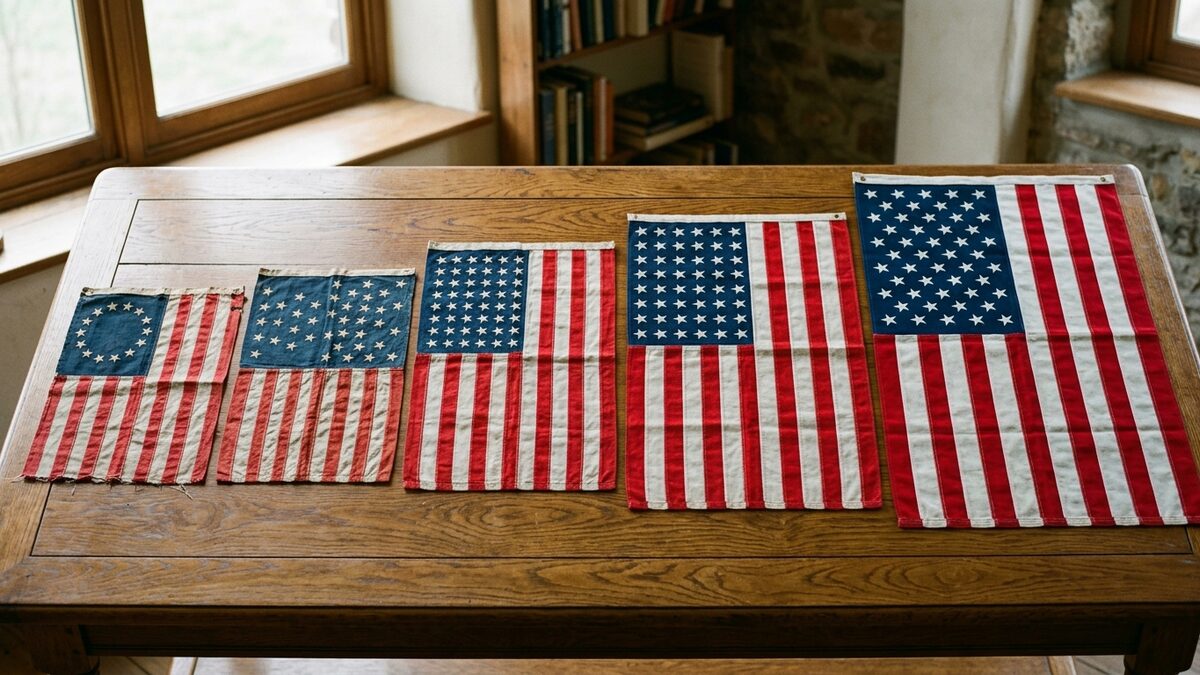
The evolution of the American flag’s star arrangement offers a compelling lens through which to examine the nation’s historical and political transformations. From its original thirteen stars arranged in a circle symbolizing unity among the first colonies, to the increasingly structured patterns that followed, each change reflects broader shifts in identity and governance. Exploring these design transitions reveals how a simple emblem encapsulates the complex narrative of American growth and aspirations.
Key Takeaways
- The arrangement of stars on the American flag has evolved to reflect the nation's growth and political changes.
- Initially, thirteen stars were arranged in a circle to symbolize the original colonies' unity.
- Star patterns transitioned from staggered rows to more structured designs by the 20th century.
- The flag serves as both a patriotic symbol and a historical record of the United States.
Since the adoption of the Stars and Stripes in 1777, the arrangement of stars on the American flag has served as a visual chronicle of the nation’s expansion and political transformation. Beginning with thirteen stars arranged in a circle to symbolize the original colonies’ unity, the flag’s design evolved with each state’s admission to the Union, reflecting the complex narrative of growth, conflict, and reconciliation. From the early staggered rows to the more structured patterns of the 20th century, changes in the star configuration mirror the shifting identity and aspirations of the United States, making the flag not only a symbol of patriotism but also a dynamic record of American history.
Early Star Arrangements and the Lack of Standardization (1777–1812)
The first official specification for the American flag was established by the Flag Resolution of June 14, 1777, which called for thirteen white stars on a blue field to represent the original colonies. However, the resolution did not prescribe a precise arrangement for these stars, leaving the design open to interpretation. Early flags from the Revolutionary War era often featured stars arranged in a circle, a design thought to symbolize equality and unity among the thirteen states. The well-known “Betsy Ross” flag, though lacking official documentation, popularized the circular arrangement with five-pointed stars pointing outward.
Since the adoption of the Stars and Stripes in 1777, the arrangement of stars on the American flag has served as a visual chronicle of the nation’s expansion and political transformation.
Throughout this period, there was considerable variation in star placement. Flag makers exercised considerable freedom, arranging stars in straight or staggered rows, or even creating large star shapes composed of smaller stars. This lack of standardization persisted until the early 20th century, with the Smithsonian Institution confirming that neither the proportions of the flag nor the star arrangements were formally regulated prior to 1912. This flexibility reflected the evolving nature of the young republic and the symbolic importance placed on unity rather than strict design rules.
The Flag Act of 1818 and the “Great Star” Era (1818–1912)
The admission of new states prompted Congress to pass the Third Flag Act on April 4, 1818, which established a fixed number of thirteen stripes to honor the original colonies and required the addition of a star for each new state admitted to the Union, effective on the following Fourth of July. This act marked a turning point in the flag’s evolution by linking the star count directly to the number of states, thereby visually narrating the country’s territorial growth.
The flag adopted under this act initially featured 20 stars and was sometimes arranged in straight rows, but more famously in the shape of a giant star, earning it the nickname “The Great Star Flag.” Throughout the 19th century, as the nation expanded westward and added states such as Alaska, Arizona, and New Mexico, the star count increased to 48 by 1912. Despite this growth, the arrangement of stars remained inconsistent, with flag makers employing various patterns including horizontal and staggered rows. The 48-star flag would become the longest-serving design before formal standardization, enduring through two world wars and embodying a period of national maturity and unity.
President Taft’s Executive Order and Grid Standardization (1912)
On June 24, 1912, President William Howard Taft issued Executive Order 1556, the first official directive to standardize the arrangement of stars on the American flag. This order established precise proportions for the flag and mandated a fixed pattern for star placement. The 48 stars were arranged in six horizontal rows of eight stars each, all aligned in a uniform grid. This formalization marked a significant shift away from the earlier era of varied and creative star configurations toward a consistent and replicable design.
Taft’s executive order reflected both practical and symbolic considerations. By creating a uniform star pattern, the flag could be reproduced accurately across various contexts, reinforcing national identity and cohesion. This standardization also acknowledged the growing complexity of the Union, offering a clear, orderly visual representation of its constituent states. The 48-star flag configuration remained official for 47 years, until the admission of Alaska and Hawaii necessitated further changes, but Taft’s order laid the groundwork for the modern practice of adjusting star arrangements with each new state while maintaining a consistent, grid-based format.