
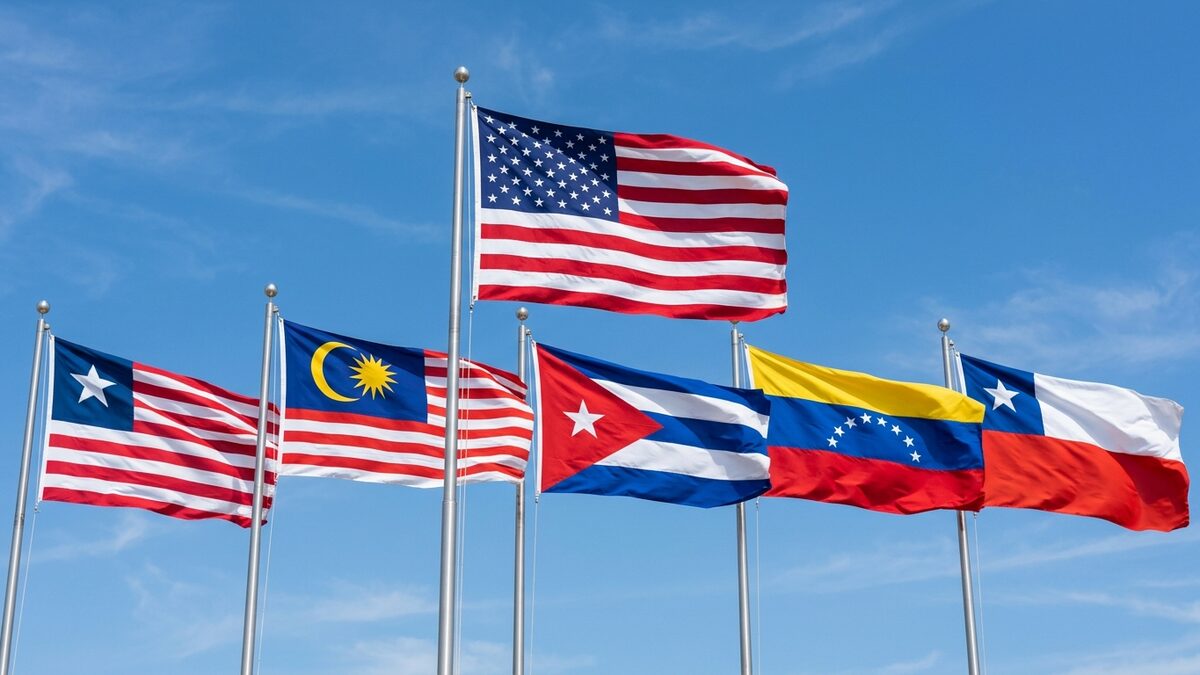
The stars and stripes motif, while iconic in the United States for its precise symbolism of unity and history, takes on diverse meanings in other national flags. Countries like Malaysia and Cuba reinterpret these elements to convey cultural narratives, religious significance, or regional pride, offering a striking contrast to the American approach. Exploring these variations reveals how flag design reflects broader national identities and values beyond mere historical representation.
Key Takeaways
- The American flag’s stars and stripes represent the original colonies and current states in a precise, federal design.
- Other countries use stars and stripes more abstractly, often as cultural or religious symbols rather than historical markers.
- Flags like Malaysia and Cuba incorporate stars and stripes to express cultural identity or revolutionary heritage.
- The US flag’s design reflects a unique semiotic significance compared to the varied symbolic uses of stars and stripes worldwide.
The American flag’s stars and stripes symbolize a specific narrative of unity and federalism, with thirteen stripes representing the original colonies and fifty stars denoting the current states. In contrast, other nations employ stars and stripes with markedly different connotations, often integrating them as abstract motifs, religious symbols, or regional identifiers rather than explicit historical markers. While the US flag’s design emphasizes a structured, almost mathematical order, flags like those of Malaysia or Cuba use stripes alongside stars to evoke cultural identity or revolutionary heritage, creating a visual language that diverges significantly from the American paradigm. This juxtaposition underscores the distinctive semiotic weight stars and stripes carry within the United States compared to their more varied or symbolic applications worldwide.
1. The United States Flag: Structured Federal Symbolism
The US flag features thirteen horizontal red and white stripes representing the original colonies and a canton with fifty white, five-pointed stars arranged in nine staggered rows, each star symbolizing a state. This design, codified legally in 1947 and last updated in 1960, embodies a precise geometric order reflecting unity and federalism. Its consistent symbolism ties historical origins directly to the present political structure, making it a unique example of stars and stripes used to denote explicit historical and political narratives.
This juxtaposition underscores the distinctive semiotic weight stars and stripes carry within the United States compared to their more varied or symbolic applications worldwide.
2. Liberia’s Flag: Emulation and Distinct Symbolism
Liberia’s flag, adopted in 1847, closely mirrors the US flag with eleven alternating red and white stripes and a blue canton containing a single white star. The eleven stripes represent the Liberian Declaration of Independence signatories, while the lone star symbolizes freedom for ex-slaves and the African continent. Here, stars and stripes are borrowed elements but reinterpreted to signify national emancipation and African identity, contrasting with the US focus on colonial unity and statehood.
3. Malaysia’s Flag: Stripes and Stars as Federal Unity and Islamic Identity
Malaysia’s flag consists of fourteen red and white stripes representing thirteen states plus the federal government, exceeding the US thirteen stripes to emphasize equal status within the federation. Its canton diverges entirely, featuring a yellow crescent and a fourteen-pointed star rather than a constellation of stars, symbolizing Islam and unity. This flag integrates stars and stripes within a framework highlighting religious and political harmony rather than historical chronology, illustrating a cultural reinterpretation of these motifs.
4. Cuba’s Flag: Revolutionary Symbolism in Stars and Stripes
The Cuban flag uses five alternating blue and white stripes with a red equilateral triangle at the hoist containing a single white five-pointed star. Unlike the US’s multiple stars representing states, the lone star here symbolizes independence and freedom from colonial rule. The stripes represent the island’s original divisions, and the red triangle evokes revolutionary ideals, demonstrating how stars and stripes can convey ideological and territorial meanings distinct from American federal symbolism.
5. Chile’s Flag: Star as a Lone Symbol of Guidance
Chile’s flag features two horizontal bands of white and red with a blue square in the canton holding a single white five-pointed star, known as the “Star of Arauco.” The single star represents guidance and honor, while the stripes symbolize the sky and blood spilled for independence. Unlike the US flag’s multiple stars indicating a political union, Chile employs a solitary star coupled with stripes to evoke national aspiration and sacrifice, reflecting a more abstract or emblematic use of these elements.