
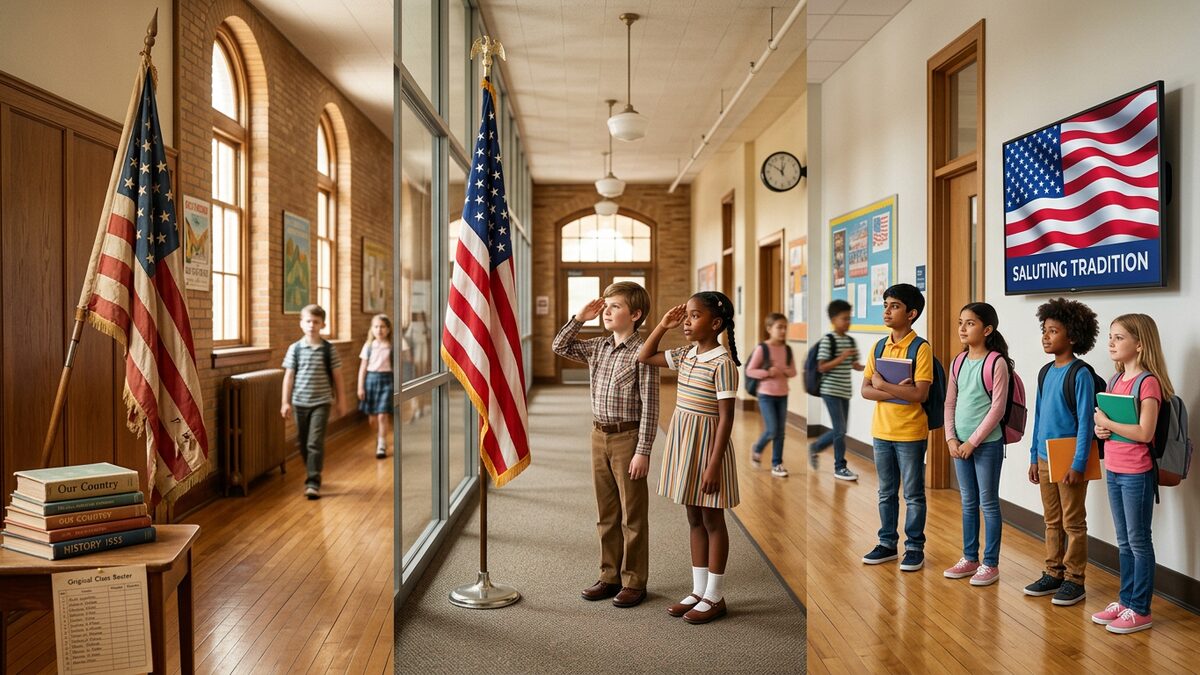
The transformation of flag etiquette in public schools reveals a nuanced dialogue between tradition and progress. As societal values and political climates have shifted, so too have the practices surrounding national symbols, moving from strict displays of patriotism to more inclusive expressions. This development raises important questions about how identity, authority, and education intersect in shaping civic understanding, inviting further examination of the forces driving these changes.
Key Takeaways
- Flag etiquette in public schools has evolved alongside changing societal values and political climates.
- Early flag rituals, like the Bellamy Salute, reflected a rigid nationalism that has since been reconsidered.
- Contemporary debates focus on balancing patriotism with inclusivity and freedom of expression.
- The history of flag protocols in schools highlights the complex relationship between identity, authority, and education.
What does it mean to honor a flag within the walls of a public school, and how has this meaning transformed over time? The evolution of flag etiquette in educational settings reflects broader shifts in societal values, political climates, and cultural awareness. From rigid displays of patriotism during early twentieth-century nationalism to contemporary debates over inclusivity and freedom of expression, the protocols surrounding the flag have continually adapted. Understanding this progression reveals not only changing attitudes toward national symbols but also the complex interplay between identity, authority, and education in American history.
Historical Origins and the Bellamy Salute
The origins of flag etiquette in public schools trace back to the late nineteenth century with the creation of the Pledge of Allegiance by Francis J. Bellamy in August 1892. Bellamy, a Baptist minister, composed the pledge for the youth-oriented publication, *Youth’s Companion*. The pledge included the phrase “one nation, indivisible, with liberty and justice for all,” encapsulating a unifying national ideal designed to foster patriotism among American children. Alongside the verbal pledge, Bellamy introduced a distinctive physical gesture known as the Bellamy Salute, which involved extending the right arm forward with the palm facing upward. This salute was intended as a sign of respect and was quickly adopted by schools nationwide.
Understanding this progression reveals not only changing attitudes toward national symbols but also the complex interplay between identity, authority, and education in American history.
By the 1890s, the Bellamy Salute had become a widespread practice in over seventy educational and governmental entities, reflecting a broader movement to standardize flag-related rituals. However, the salute’s visual resemblance to the Nazi “Sieg Heil” salute, which emerged in the 1930s, precipitated concerns about its appropriateness. This similarity would later catalyze significant changes in flag etiquette during the mid-twentieth century, signaling the first major transformation in public school flag protocols.
The 1942 U.S. Flag Code and WWII Context
The outbreak of World War II intensified the need for national unity and standardized symbols of patriotism, culminating in the enactment of the U.S. Flag Code by Congress in 1942. This legislation established uniform guidelines for the display and respect of the American flag, including explicit mandates for schools. According to Title 4, Chapter 1 of the Code, the flag was to be displayed daily in every schoolhouse on school days, underscoring its symbolic significance in shaping civic identity among youth.
A pivotal reform introduced by the 1942 Flag Code was the abolition of the Bellamy Salute. In its place, students and citizens were instructed to place their right hand over their heart when reciting the Pledge of Allegiance. This change sought to eliminate any confusion or negative associations arising from the salute’s similarity to fascist gestures. The Code also emphasized that “No disrespect should be shown to the flag of the United States of America,” a principle that became the foundation for subsequent school policies regarding both the physical handling of the flag and the conduct expected during its display. These regulations reflected the era’s heightened focus on conformity, respect for national symbols, and the reinforcement of patriotic education during wartime.
Supreme Court Decisions and Modern Flag Etiquette
The latter half of the twentieth century introduced complex legal debates surrounding flag etiquette in public schools, especially related to individual rights under the First Amendment. Landmark Supreme Court rulings such as West Virginia State Board of Education v. Barnette (1943) fundamentally altered the landscape of flag protocol. In that decision, the Court held that students could not be compelled to salute the flag or recite the Pledge of Allegiance, affirming that mandatory participation violated freedom of speech and expression. This ruling marked a critical shift from enforced uniformity to voluntary observance, emphasizing respect for personal conscience within educational settings.
Subsequent developments saw states enacting mandatory flag display laws as part of their education codes, often requiring the flag to be present in classrooms and the Pledge to be offered daily. Nonetheless, policies increasingly accommodated students’ rights to abstain from participation. Modern flag etiquette in public schools incorporates legal protections ensuring that while the flag remains a prominent symbol, respect for diverse beliefs and freedom of expression is upheld. Many districts now adopt voluntary display policies, balancing tradition with inclusivity, and reflecting evolving societal values that recognize the pluralistic nature of American identity.