The narrative of Betsy Ross and the creation of the first American flag remains a compelling intersection of legend and historical inquiry. As the Continental Congress sought a unifying symbol in 1776, Ross’s reputed role in sewing the stars and stripes has sparked debate among historians. Exploring her contribution invites a deeper understanding of how myth and fact intertwine in the formation of national identity.
Key Takeaways
- Betsy Ross was a skilled upholsterer who made uniforms, tents, and flags for Continental forces during the American Revolution.
- Family stories claim George Washington asked Ross to sew the first American flag, though this is hard to verify.
- Ross’s connection to the first American flag blends historical fact with myth and legend.
- She managed her own upholstery business as a widow in wartime Philadelphia, showcasing her expertise and independence.
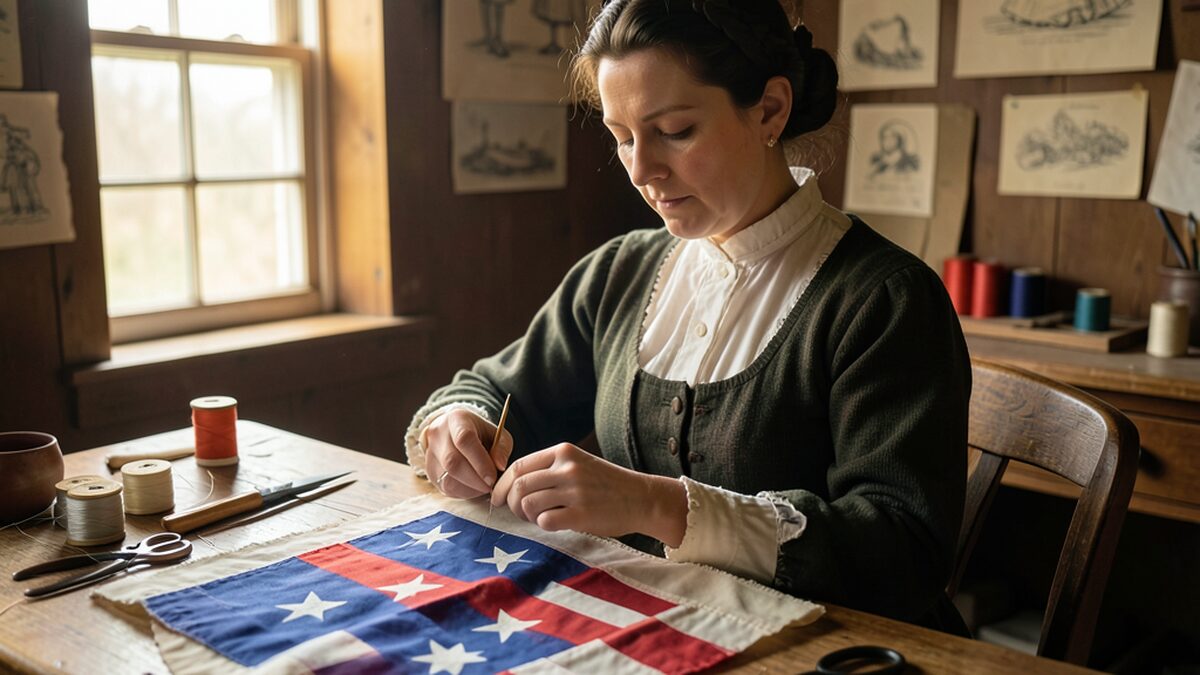
In the summer of 1776, as the Continental Congress debated the design of a new national emblem, a modest upholsterer named Betsy Ross sat quietly in her Philadelphia workshop, stitching fabric by candlelight. According to family lore passed down through generations, it was during this unassuming moment that General George Washington himself visited Ross, seeking her skilled hands to sew the first American flag. This anecdote, though difficult to verify, has become emblematic of Ross’s enduring association with the birth of the stars and stripes, highlighting the intersection of myth and history in early American flag lore.
Who Betsy Ross Was
Elizabeth Griscom Ross, commonly known as Betsy Ross (1752–1836), was a skilled upholsterer and seamstress based in Philadelphia. She operated an upholstery business that produced uniforms, tents, and flags for Continental forces during the American Revolution. Colonial Williamsburg notes that Ross was a widow managing her own business, which contextualizes her expertise in textiles and her presence in wartime Philadelphia. Her documented contributions to the war effort primarily involved her upholstery skills rather than flag-making per se.
According to family lore passed down through generations, it was during this unassuming moment that General George Washington himself visited Ross, seeking her skilled hands to sew the first American flag.
The popular image of Ross as the creator of the first American flag arises from a combination of family tradition, later storytelling, and surviving business records. Unlike many historical figures of the Revolution, there is no single contemporary official account that explicitly names her as the flag’s maker. Instead, her reputation is a product of evolving narratives that have embedded her in the symbolic history of the United States.
The Legend of the First Flag
The most enduring story associated with Betsy Ross claims that General George Washington visited her Philadelphia workshop in early June 1776, accompanied by Colonel George Ross and Robert Morris. According to family lore, Washington presented a rough sketch of a new American flag featuring thirteen stripes and six-pointed stars. Betsy Ross is said to have suggested substituting five-pointed stars for the six-pointed ones, a design change that Washington then approved and redrew.
Subsequently, the narrative holds that these men requested Ross to sew the first official American flag based on this revised design. This version of events has been widely recounted in popular histories and commemorations, linking Ross intimately to the creation of the stars and stripes. However, this story survives predominantly through oral tradition and was first publicly documented decades after the Revolution, casting doubt on its historical accuracy.
What the Official Record Does and Does Not Show
Despite the compelling nature of the Betsy Ross legend, historians have found no contemporary evidence to corroborate the specific claims regarding her role in the flag’s design or production. Extensive searches through diaries, letters, and Continental Congress journals have failed to reveal references to Ross or the flag-making event described by her descendants. The National Postal Museum emphasizes that these claims remain unverified, highlighting the absence of primary documentation from the Revolutionary era.
While Betsy Ross undoubtedly contributed to the war effort through her upholstery work, the official record does not confirm her as the designer or maker of the first American flag. Her story exemplifies how myth and family tradition can shape national memory, reinforcing symbolic narratives even in the absence of explicit historical proof. Thus, Ross’s role in early American flag history occupies a complex space between documented fact and enduring legend.