
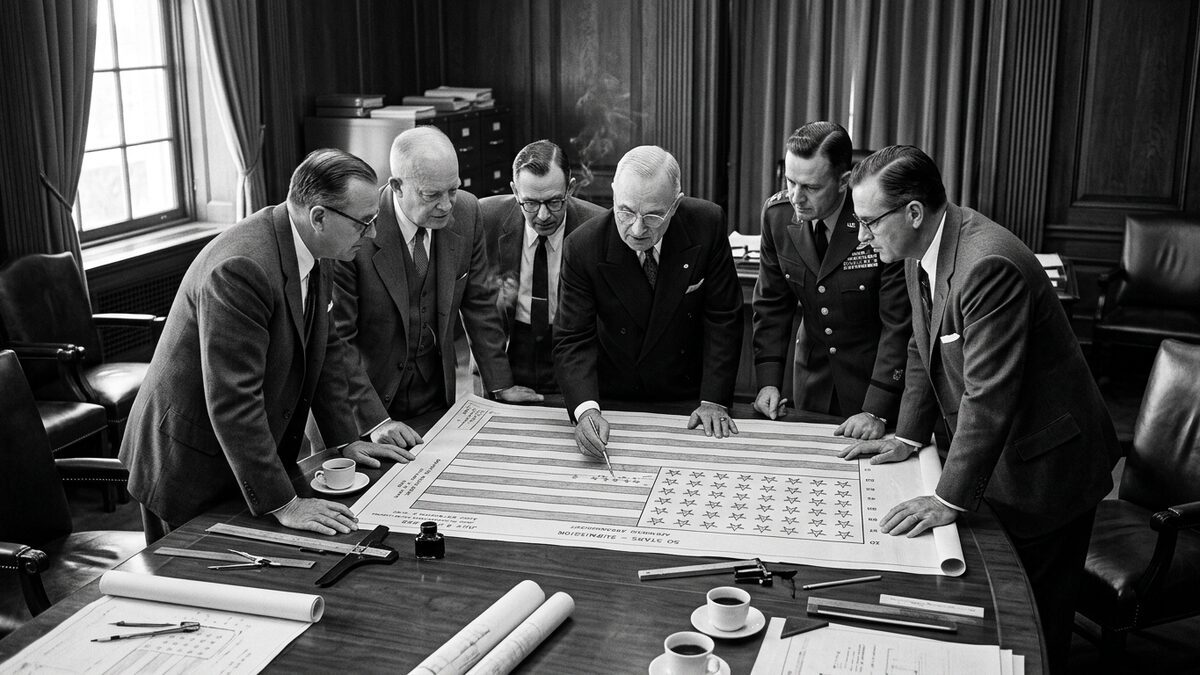
The adoption of the 50-star flag in 1960 marks a pivotal moment in American history, symbolizing the nation’s evolving identity and territorial expansion. Emerging from the inclusion of Hawaii as the 50th state, this design encapsulates both historical tradition and political progress. Exploring the origins and significance of this emblem offers insights into how the United States visually represents its unity and growth during a transformative era.
Key Takeaways
- The 50-star flag was officially adopted on July 4, 1960, following Hawaii's admission as the 50th state.
- The Flag Act of 1818 established the practice of adding a star for each new state on the flag.
- The addition of Alaska and Hawaii required a new flag design to represent the expanded Union.
- Thousands of Americans, including schoolchildren, contributed design ideas for the new flag.
The design of the 50-star flag, officially adopted on July 4, 1960, traces its origins to a pivotal moment in American history—the admission of Hawaii as the 50th state on August 21, 1959. This expansion of the Union necessitated a new emblematic banner, continuing a tradition dating back to the Flag Act of 1818, which established the practice of adding stars to represent each state. The 50-star flag thus embodies a tangible reflection of the nation’s evolving political landscape during the mid-20th century, symbolizing both unity and the culmination of continental and insular expansion.
Background: Why a New Flag Was Needed
The requirement to update the United States flag stems from the Flag Act of 1818, which mandated the addition of a star for each new state admitted to the Union, with the change taking effect on the following July 4. By 1959, the impending statehood of Alaska and Hawaii as the 49th and 50th states respectively triggered the need for a new flag design. This event captured significant public interest, with thousands of citizens, including a large number of schoolchildren, submitting design proposals to the White House. President Dwight D. Eisenhower responded by appointing a committee to oversee the selection process, ensuring the new flag would maintain an official and orderly appearance despite the increased number of stars.
The 50-star flag thus embodies a tangible reflection of the nation’s evolving political landscape during the mid-20th century, symbolizing both unity and the culmination of continental and insular expansion.
Robert G. Heft’s Student Project
One of the most notable contributions to the 50-star flag’s origin was by Robert G. Heft, a junior at Lancaster High School in Ohio, who crafted a 50-star flag as part of a school history project in 1958. Inspired by the legendary Betsy Ross and her association with the first American flag, Heft meticulously cut 50 white stars from iron-on material and affixed them to a blue cloth field that he sewed onto his parents’ existing 48-star flag. The project took him more than 12 hours to complete. Heft later submitted his design to the White House, where it entered the competition for the official new flag design. His work would eventually gain national recognition as part of the selection process.
Competing Designs and Official Selection
The Eisenhower administration received over 3,000 submissions for the new flag design, reflecting widespread enthusiasm and creativity. The committee tasked with recommending the final design reviewed numerous “creative and fanciful” proposals but ultimately sought to preserve the flag’s dignified and familiar appearance. The recommended design featured a pattern similar to the existing 48-star flag, arranged in seven staggered rows of seven stars each. This arrangement was adopted after Alaska’s statehood was confirmed, providing a balanced and visually coherent layout for the addition of the 49th and 50th stars. The finalized 50-star flag was officially adopted on July 4, 1960, marking the culmination of the nation’s expansion and the origin and adoption of the 50-star flag in 1960 as a symbol of unity and national identity.