
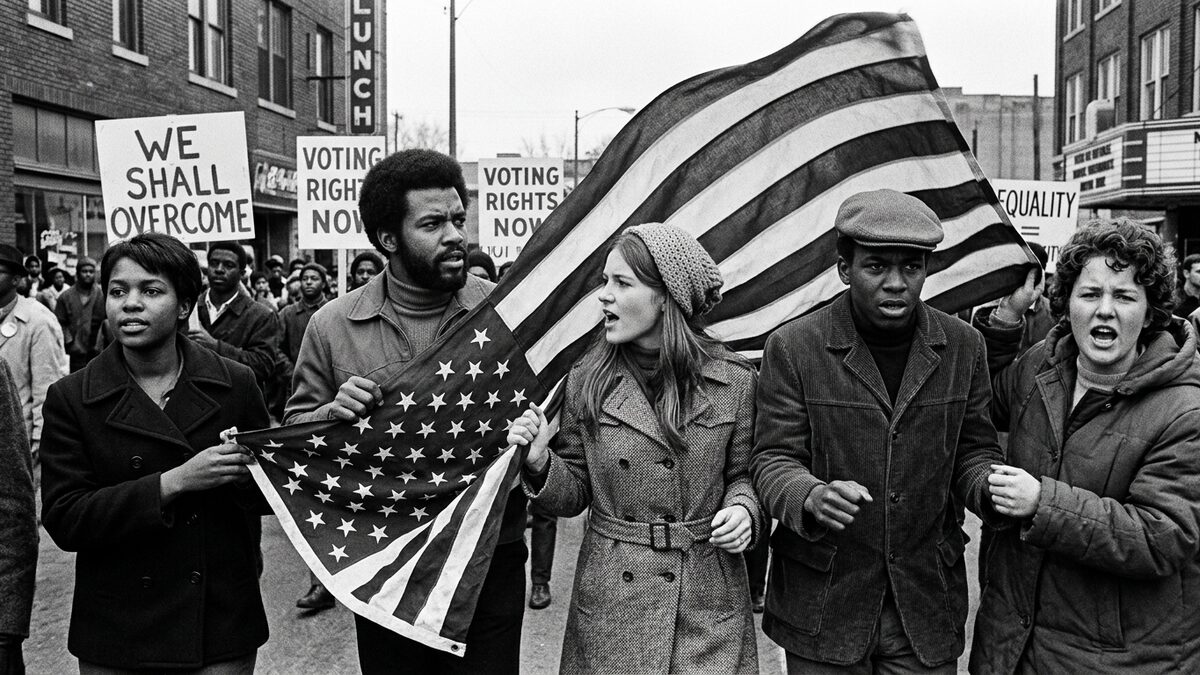
The American flag has long stood as a powerful and multifaceted symbol in the struggle for racial equality throughout the 20th century. Its presence in moments of both military valor and civil rights activism underscores a profound duality—representing national ideals while simultaneously exposing deep societal contradictions. Exploring this complex relationship reveals how the flag became a contested emblem, embodying both patriotism and protest during a transformative era in American history.
Key Takeaways
- The American flag symbolized both unfulfilled promises and hope during civil rights protests.
- In the 1960s, activists used the flag to demand justice and equality from the nation.
- The flag highlighted the tension between patriotism and protest in the fight for racial rights.
- It served as a contested emblem where ideals of freedom were publicly challenged and debated.
From the iconic image of African American soldiers raising the American flag at Iwo Jima during World War II to the turbulent streets of the 1960s civil rights marches, the American flag has served as a potent symbol in the struggle for racial equality. Throughout the 20th century, activists and demonstrators invoked the flag both as a representation of the nation’s unfulfilled promises and as a banner of hope for justice and inclusion. This duality underscored the complex relationship between patriotism and protest, revealing how the flag functioned not merely as a national emblem but as a contested site where ideals of freedom and equality were publicly debated and demanded.
The American Flag as a Pro-Civil Rights Symbol in the 1960s
During the 1960s, the American flag emerged as a significant pro-civil rights emblem, reflecting a shift in its cultural and political meaning. Civil rights activists prominently carried the flag to challenge the nation to live up to the promises embedded in its founding documents, particularly freedom and equality. As noted by the Smithsonian’s National Museum of American History, the flag became a “contested symbol of pride and protest,” representing both the aspirations and contradictions of American democracy during a period marked by intense social divisions. This reappropriation of the Stars and Stripes was especially pronounced among younger activists who, according to the Portland Flag Association, had “reclaimed the Stars and Stripes as their own” by the late 1950s, signaling a generational and ideological realignment of the flag’s symbolism.
This duality underscored the complex relationship between patriotism and protest, revealing how the flag functioned not merely as a national emblem but as a contested site where ideals of freedom and equality were publicly debated and demanded.
The flag’s deployment in civil rights protests underscored its dual role as an emblem of national identity and a tool for social critique. In the South, the American flag became a potent symbol supporting racial integration and federal civil rights legislation, as documented by Civil Rights Teaching. This appropriation illuminated the broader cultural contest over what the flag represented—whether a symbol of exclusion and segregation or one of inclusion and justice. Through this lens, the flag was not a static icon but an active participant in the struggle for civil rights, embodying the tensions between patriotism and protest.
Signaling Support for Federal Desegregation Through the Flag
Civil rights activists used the American flag strategically to express explicit support for federal desegregation efforts, particularly in the Southern United States where resistance to integration was fierce. Carrying the flag in protests and marches was a visible assertion of allegiance to constitutional principles over segregationist local laws and customs. Civil Rights Teaching highlights that even a child carrying the American flag in Mississippi represented a form of defiance against entrenched racial discrimination and state-sanctioned segregation.
The flag’s durability as a protest tool was also practical: unlike signs, which could be easily confiscated or destroyed, flags were more difficult for authorities to seize without attracting public attention. The Portland Flag Association points out that police officers’ attempts to remove flags often generated powerful images that amplified the civil rights movement’s message. The National Museum of American History further emphasizes that the flag was employed not as a neutral national emblem but as a visible affirmation of the constitutional ideals of freedom and equality that protesters demanded the nation fulfill. This framing positioned the American flag as a banner of legal and moral authority in the face of systemic racial injustice.
The Rise of the Confederate Flag Among Segregationists
As civil rights activists embraced the American flag to advocate for equality and federal authority, segregationists increasingly distanced themselves from the national symbol. By the late 1950s, many segregationists had largely abandoned the U.S. flag in favor of the Confederate flag, which they adopted as a symbol of resistance to federally mandated desegregation. The Portland Flag Association notes this shift, highlighting how the Confederate flag became the emblem of opposition to the civil rights movement and the federal government’s intervention in state affairs.
The Smithsonian Institution corroborates this trend, documenting how white segregationists prominently displayed the Confederate flag to signal their rejection of integration and the federal civil rights agenda. This symbolic divergence between the American flag and the Confederate flag reflected and intensified the cultural and political polarization of the era. While the American flag was increasingly associated with calls for justice and inclusion, the Confederate flag was appropriated as a symbol of defiance and racial exclusion, underscoring the contested meanings of national identity during the 20th century Civil Rights Protests.