
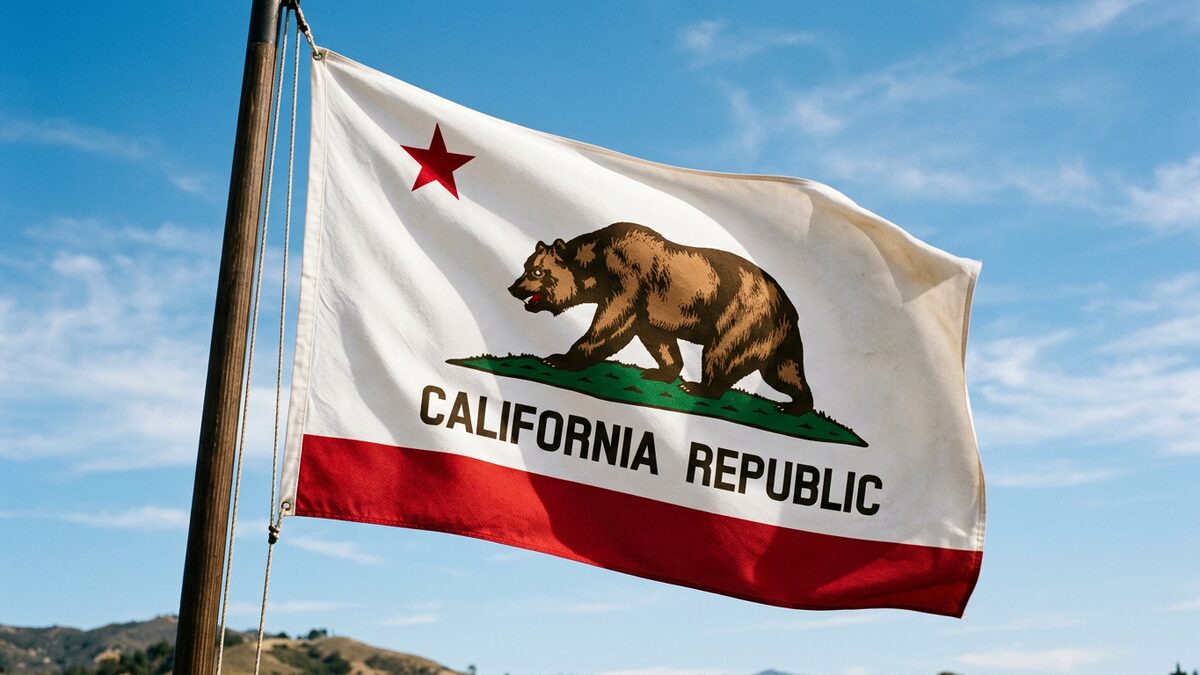
The California State Flag stands as a powerful emblem rooted in a pivotal moment of rebellion and identity formation during the 1846 Bear Flag Revolt. Its original design, marked by a grizzly bear and lone star, encapsulated the settlers’ resolve and emerging vision for independence. Exploring the flag’s evolution reveals how its symbolism has adapted to embody California’s diverse heritage, political landscape, and natural splendor, offering a fascinating lens on the state’s history.
Key Takeaways
- The California State Flag originated from the Bear Flag Revolt of 1846.
- Its design features a grizzly bear and a lone star symbolizing defiance and independence.
- The flag reflects California's natural beauty, political history, and cultural heritage.
- William L. Todd, related to Mary Todd Lincoln, created the original flag under urgent conditions.
In the aftermath of the Bear Flag Revolt of 1846, when American settlers in California declared independence from Mexican rule, a distinctive banner was raised that would come to symbolize the state’s unique identity and tumultuous origins. This initial Bear Flag, hastily crafted and emblazoned with a grizzly bear and a lone star, encapsulated the spirit of defiance and aspiration that defined California’s brief sojourn as a self-proclaimed republic. Over time, this emblem evolved into the official state flag, its design and symbolism reflecting the complex interplay of natural grandeur, political ambition, and cultural heritage that has shaped California’s history.
Origins in the Bear Flag Revolt (1846)
The design history and symbolism of the California State Flag trace back directly to the Bear Flag Revolt of June 1846. This brief uprising was led by American settlers in Sonoma who sought to end Mexican authority in the region by proclaiming an independent California Republic. Central to this declaration was a homemade flag, created under pressing circumstances by William L. Todd, a figure connected to national history as the nephew of Mary Todd Lincoln. Todd’s design featured a rudimentary silhouette of a grizzly bear, a five-pointed star, and a bold red stripe, along with the inscription “California Republic.”
This initial Bear Flag, hastily crafted and emblazoned with a grizzly bear and a lone star, encapsulated the spirit of defiance and aspiration that defined California’s brief sojourn as a self-proclaimed republic.
Although the revolt lasted only about a month and did not achieve lasting independence, the flag raised during this period captured the settlers’ aspirations and resistance. Its imagery became an enduring symbol of California’s defiant spirit and the settlers’ determination to forge a new political identity. This initial banner laid the groundwork for the flag that would later be formally adopted as the state emblem, embodying the early conflicts and ambitions that shaped California.
Evolution to Official State Adoption (1911–1953)
The transition from the original Bear Flag to the official state flag was a gradual process marked by historical events and legislative actions. On February 3, 1911, California’s legislature officially adopted a flag inspired by the 1846 design, seeking to formalize the symbol that had become synonymous with the state’s identity. This adoption came after the original Todd-designed Bear Flag was lost during the San Francisco earthquake of 1906, necessitating a recreation that honored the original’s spirit while adapting to contemporary standards.
Despite the official adoption in 1911, the flag’s design elements and color schemes were not standardized until 1953. This later legislative action refined the flag’s specifications, affirming the central position of the grizzly bear and formally designating the California Grizzly as the official State Animal. The 1953 standardization solidified the flag’s role as a visual encapsulation of California’s heritage, blending historical reference with natural symbolism in a carefully regulated design.
Symbolism of the Grizzly Bear
The grizzly bear at the heart of the California State Flag is a potent symbol of strength, resilience, and the untamed spirit of the region. The image is based on “Monarch,” the last wild California grizzly bear held in captivity, who died in 1911—the same year the flag was officially adopted. This connection underscores the bear’s emblematic status as a representation of the once-abundant grizzly populations that roamed California’s diverse landscapes.
Beyond its portrayal of physical power and endurance, the grizzly bear serves as a reminder of the environmental and cultural transformations California has experienced. As the official State Animal, designated by legislation in 1953, the bear embodies both historical significance and ecological heritage. Its presence on the flag symbolizes not only the natural grandeur of California but also the enduring values of courage and determination that have defined the state’s identity throughout its history.