
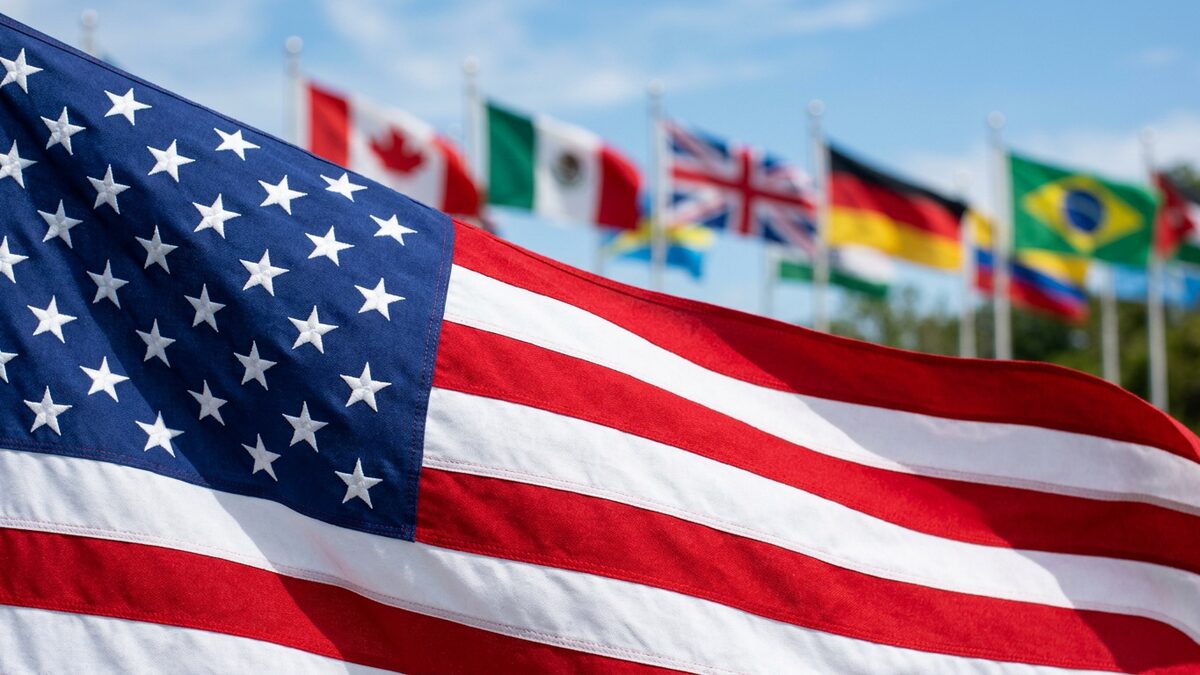
The American flag stands apart from many national flags through its intricate combination of stars and stripes, each element carrying distinct historical and symbolic weight. This design not only represents unity among states but also conveys a deeper narrative of federalism and independence. Exploring these differences reveals how the flag’s complexity contrasts with the simpler, often more abstract symbols found on other nations’ banners, offering unique insights into national identity and ideology.
Key Takeaways
- The American flag uniquely combines stars and stripes to represent both states and original colonies.
- Its design is more complex than the simpler tricolor or emblem-based flags of other nations.
- The flag’s symbolism emphasizes federalism and historical continuity.
- The Stars and Stripes balance multiplicity and coherence in their layered narrative.
The American flag, with its distinctive field of fifty white stars set against a deep blue canton and thirteen alternating red and white stripes, stands in stark contrast to the often simpler, more uniform designs of other national flags. While many countries employ tricolor bands or singular emblems to convey national identity, the American flag’s complex arrangement symbolizes both unity and historical continuity, merging the representation of individual states with the original colonies. Unlike flags that prioritize minimalism or abstract symbolism, the Stars and Stripes intricately balance multiplicity and coherence, foregrounding a layered narrative of federalism and independence that sets it apart in both design complexity and ideological expression.
1. Structural Design: Stripes and Stars Configuration
The United States flag uniquely combines thirteen horizontal stripes with fifty white stars arranged in nine offset horizontal rows, alternating between six and five stars. This design, standardized in 1960, permanently retains the thirteen stripes to honor the original colonies while adding stars for each state, contrasting with other national flags that often adopt simpler, unified patterns or modify stripe counts with territorial changes. This legally codified structure under 4 U.S.C. § 1 emphasizes a dual symbolism of origin and expansion not commonly found in other flags.
Unlike flags that prioritize minimalism or abstract symbolism, the Stars and Stripes intricately balance multiplicity and coherence, foregrounding a layered narrative of federalism and independence that sets it apart in both design complexity and ideological expression.
2. Color Symbolism and Official Meanings
Unlike many national flags whose colors carry broadly cultural or historical associations, the American flag’s colors have officially assigned meanings rooted in the Great Seal of 1782: red symbolizes valor and bravery, white denotes purity and innocence, and blue represents vigilance, perseverance, and justice. These meanings were not originally specified in 1777 but were formally articulated later, including a modern interpretation by President Reagan in 1986, giving the flag’s palette a codified ideological depth. This contrasts with flags where color symbolism is either ambiguous or varies by historical context.
3. Historical Evolution and Standardization Dates
The American flag’s evolution is marked by a series of legal adoptions and modifications, beginning with its official adoption on June 14, 1777, and culminating in the last change in 1960 with the addition of Hawaii’s star. Unlike many national flags that maintain static designs or change infrequently, the U.S. flag adapted repeatedly to the nation’s expansion, with legislative acts altering star arrangements while preserving the foundational stripe count. This dynamic yet codified evolution reflects the federalist nature of the United States, distinguishing it from flags that prioritize fixed symbolism over territorial representation.
4. Symbolic Representation of Federalism
The American flag explicitly embodies a federalist system by symbolizing both the original colonies (through stripes) and the current states (through stars), a dual-layer symbolism rarely seen in other national flags. Most flags emphasize a singular national or ethnic identity without codifying political subdivisions visually. This layered approach integrates historical continuity with present unity, making the Stars and Stripes a graphic representation of the country’s unique political structure rather than merely a national emblem.
5. Complexity Versus Minimalism in Design Philosophy
Compared to many national flags that favor minimalism—often employing tricolor horizontal or vertical bands and simple emblems—the American flag exhibits a relatively complex design with multiple elements and precise star arrangements. This complexity conveys a narrative of multiplicity and unity, balancing detailed federal symbolism with overall coherence. Other flags tend to adopt more abstract or singular symbols to represent national identity, whereas the U.S. flag’s intricate patterning foregrounds its historical and ideological narrative.