
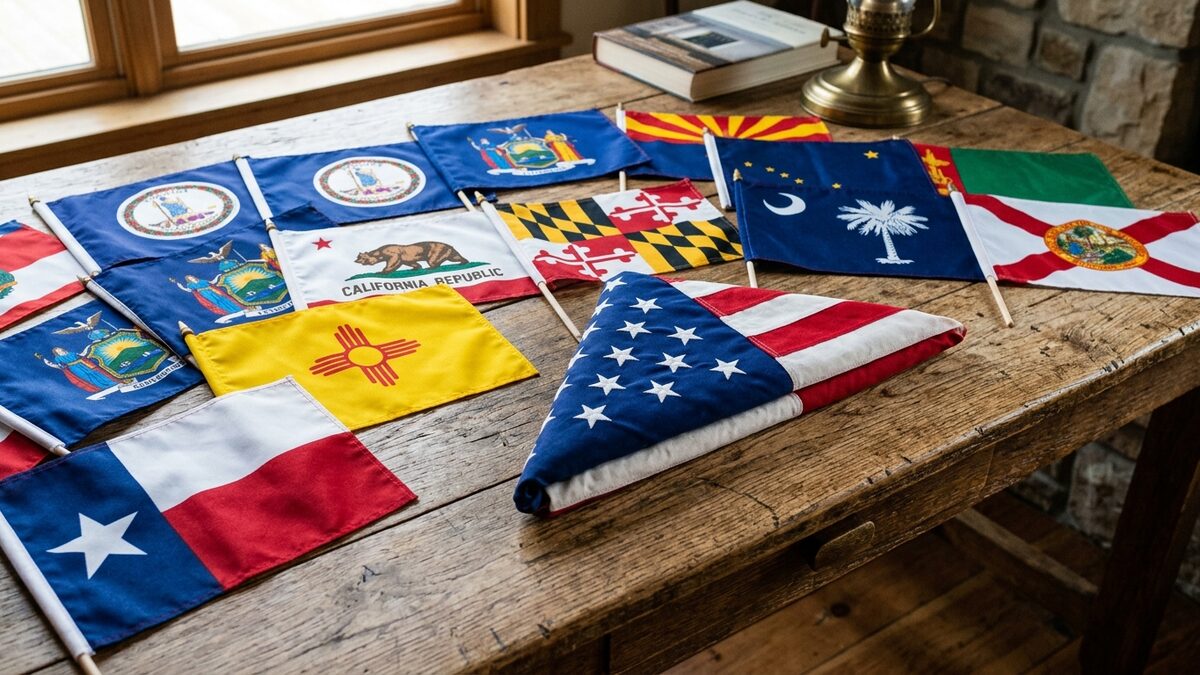
The article explores the striking contrast between the national flag’s uniform symbolism of unity and the intricate designs of state flags, which capture unique regional histories and cultural identities. By examining how state flags serve as visual records of local heritage, the discussion reveals the layered narratives that contribute to the nation’s diverse fabric. This perspective invites a deeper appreciation of the ways flags embody both collective ideals and distinct community stories.
Key Takeaways
- State flags highlight unique regional histories and cultural identities distinct from the national flag's unity.
- The national flag symbolizes collective nationhood with uniform elements representing shared ideals.
- State flags act as visual archives preserving local heritage and historical moments.
- The contrast between state and national flags reflects the complex tapestry of diverse histories within the nation.
The stark simplicity of the national flag, with its uniform stripes and stars symbolizing unity and collective identity, stands in deliberate contrast to the intricate and varied designs of state flags, each embodying distinct regional narratives and historical nuances. While the national flag conveys a cohesive story of nationhood forged through shared ideals, state flags often serve as visual archives, preserving local heritage, cultural diversity, and unique historical moments that the broader emblem overlooks. This juxtaposition reveals how state flags function not merely as symbols of political boundaries but as expressions of localized identity, reflecting the complex tapestry of histories that comprise the nation.
Regional Identity Versus National Unity
State flags in the United States articulate a sense of localized identity that often diverges from the unified symbolism of the national flag. Whereas the national flag emphasizes the unity of the states as a single political community, state flags foreground the distinctiveness of their regions by incorporating symbols that highlight local history, geography, culture, and economic foundations. This differentiation became especially pronounced during events like the 1893 Chicago World’s Fair, when states sought to assert their individuality through unique emblems that could be recognized in a national and international context. Through this lens, state flags serve as visual compromises that balance pride in regional heritage with a broader allegiance to the federal union, illustrating the coexistence of state pride alongside national belonging.
State flags often serve as visual archives, preserving local heritage, cultural diversity, and unique historical moments that the broader emblem overlooks.
Historical Events Embedded in Designs
Many state flags encapsulate pivotal moments and narratives unique to their histories, using symbols that commemorate regional struggles, alliances, and identities. For example, Alabama’s flag deliberately echoes the Confederate battle flag, signaling its historical ties to the Confederacy during the Civil War era. California’s flag recalls the 1846 Bear Flag Revolt, a short-lived rebellion against Mexican rule, while its adoption in 1911 formalized this symbol of early statehood and independence. New Mexico’s flag uniquely melds Spanish colonial colors with the Indigenous Zia sun symbol, reflecting a dual heritage that spans centuries. Tennessee’s flag, with its three stars, represents both its geographic tripartite division and its place as the third state admitted after the original thirteen, weaving statehood into its iconography. Such examples demonstrate how state flags are repositories of regional memory, embedding nuanced historical narratives that are absent from the national flag’s broader symbolism.
Indigenous and Colonial Heritage
State flags frequently incorporate elements that acknowledge Indigenous influences and colonial legacies, often intertwining these to express complex regional identities. Arizona’s flag, for instance, features thirteen red and yellow rays symbolizing the original colonies while also referencing the colors associated with Spanish explorers who arrived in 1540. New Mexico’s prominent use of the Zia sun symbol explicitly foregrounds Native American heritage, underscoring Indigenous cultural impact within state iconography. Hawaii’s flag notably integrates the Union Jack, reflecting its historical relationship with Britain before its eventual integration into the United States. These designs reveal how state flags preserve layered histories of colonization, exploration, and Indigenous presence, offering a visual narrative that contrasts with the national flag’s emphasis on unity and federal identity. Collectively, they underscore the role of state flags in articulating the diverse cultural and historical influences that define their regions.