
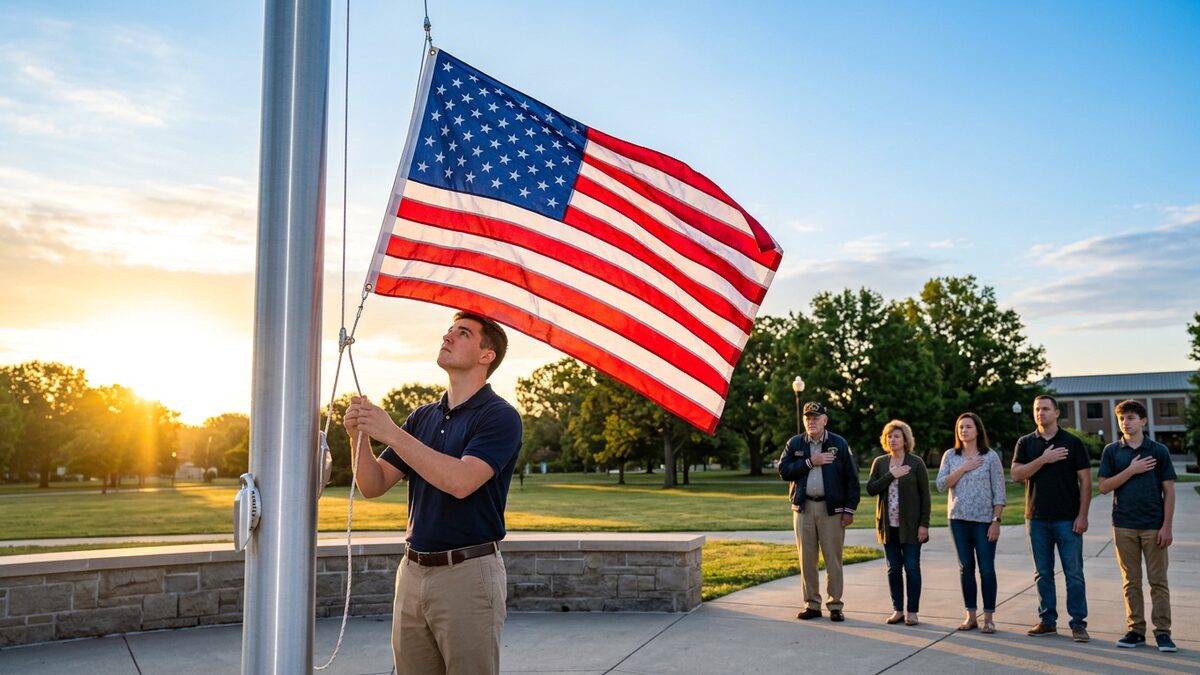
The United States Flag Code, established in 1942, serves as a vital framework for honoring the American flag’s symbolism and heritage. By outlining precise etiquette for display and handling, it reinforces national unity and respect. Exploring these standards reveals how the flag’s dignity is maintained through changing social and political landscapes, inviting a deeper understanding of its enduring role in American identity.
Key Takeaways
- The US Flag Code was established in 1942 to standardize respect for the American flag.
- The flag should be displayed from sunrise to sunset on buildings and stationary flagstaffs.
- The flag may be flown at night only if it is properly illuminated.
- The Flag Code aims to preserve the dignity of the flag amid social and political changes.
Since the Betsy Ross flag first flew over Philadelphia in 1777, the American flag has served as a powerful emblem of national identity and unity. As the nation evolved, the need for standardized respect toward this symbol became evident, culminating in the adoption of the United States Flag Code in 1942. This set of guidelines was established to ensure uniformity in the flag’s display and handling, reflecting the flag’s enduring role as a representation of the country’s ideals and history. By codifying proper flag etiquette, the Flag Code seeks to preserve the dignity of the American flag amid changing social and political landscapes.
Time of Display and Illumination Requirements
The US Flag Code Guidelines for Proper Flag Display and Handling specify that the flag should be displayed only from sunrise to sunset when flown on buildings and stationary flagstaffs in open areas. This temporal limitation underscores the importance of presenting the flag during daylight, when its colors and symbolism are most visible and honored. However, the Code does permit the flag to remain flying at night, provided it is properly illuminated. This illumination must be sufficient to make the flag clearly visible during hours of darkness, a standard echoed by organizations such as the American Legion and the Department of War, which emphasize that unlit flags must be lowered after dark to maintain respect.
By codifying proper flag etiquette, the Flag Code seeks to preserve the dignity of the American flag amid changing social and political landscapes.
Additionally, the National Flag Foundation advises against flying the flag in inclement weather unless it is an all-weather flag specifically designed for such conditions. This nuanced guidance reflects the Flag Code’s balance between the desire to display the flag continuously and the imperative to protect its physical integrity and symbolic dignity.
Weather Conditions and Flag Integrity
The US Flag Code explicitly restricts the outdoor display of the flag during adverse weather conditions such as rain, snow, or high winds. This provision aims to prevent unnecessary wear and damage to the flag, preserving its appearance as a revered national symbol. However, an important exception exists for all-weather flags, which are constructed from synthetic materials engineered to withstand inclement weather without degradation. These durable flags allow for continuous display while adhering to the Code’s spirit of respect.
Further emphasizing the importance of maintaining the flag’s dignity, organizations like the Veterans of Foreign Wars and the American Legion insist that flags be clean, undamaged, and free from wrinkles or tears. When a flag becomes too worn or tattered to serve as an adequate representation of the nation, guidelines from the National Flag Foundation recommend its dignified retirement, preferably through burning, to honor its service and symbolism. This ritual underscores the reverence accorded to the flag within the US Flag Code Guidelines for Proper Flag Display and Handling.
Hoisting, Lowering, and Half-Staff Protocol
The US Flag Code outlines precise protocols for raising and lowering the flag to convey respect and solemnity. Upon hoisting, the flag should be raised briskly to the peak of the flagpole, symbolizing honor and pride. Conversely, lowering the flag must be conducted slowly and ceremoniously to reflect reverence; the flag should never be allowed to touch the ground. These procedures ensure that the flag’s treatment remains dignified at all times during daily display.
Special attention is given to the half-staff position, which signals national mourning or respect for significant events. When flying the flag at half-staff, it must first be raised promptly to the peak, then lowered to the half-staff position. At the conclusion of the day’s display, the flag should be raised back to the peak before being fully lowered. This ritualized sequence reinforces the flag’s role as a living symbol of collective memory and solemn recognition, as codified in the US Flag Code Guidelines for Proper Flag Display and Handling.